We get calls from parks departments, school athletic directors, and club coaches who are ready to break ground on a field — and have been quoting pile height specs for weeks without knowing what the numbers actually mean. Artificial turf for sports fields is one of those purchases where the spec sheet looks like a foreign language, and getting it wrong on a 50,000-square-foot field costs a lot more than getting it wrong on a backyard. That’s not a knock on anyone. It’s just turf doing what turf does: hiding the important stuff under a price.
So here’s the straight version. A good sports field comes down to four decisions — pile height, infill, backing and drainage, and whether you need a shock pad — all matched to how the field actually gets used. Get those right and everything else is detail. If you’re still working out square footage and budget, our turf cost calculator is a fine place to start the numbers conversation. Two of those four decisions — getting the infill volume right and planning for how long the field has to last — are where most of the budget and most of the mistakes live.
TL;DR — Quick Answer
Choosing turf for a sports field is four decisions matched to your use: pile height (longer for soccer, shorter for football and lacrosse, mid-range for multi-sport), infill system, backing and drainage, and a shock pad for organized and contact play. Spec the base and the primary sport first — pile and infill follow from there. Budget for the whole system, not just the roll, and the field lasts 8 to 15 years.
Best pile for soccer
2" to 2.25"
Best pile for football
1.5" to 1.75"
Field lifespan
8 to 15 years
Most common mistake
Skimping on the base
Planning a Sports Field?
Tell us your dimensions, primary sport, and use schedule. We'll help you spec the right system and give you a cost range to bring to your committee — no pressure, no obligation.
Table of Contents
Key Takeaways
- Pile height is sport-specific — 2 to 2.25 inches for soccer, 1.5 to 1.75 inches for football and lacrosse, and a mid-range pile for a multi-sport field that has to do a bit of everything.
- Infill is as important as the fiber itself — the wrong infill makes an otherwise good product play poorly, and in Arizona a cooler infill is worth specifying.
- A shock pad beneath the backing is now standard for organized youth play and contact sports, and often required by a governing body or district policy.
- Drainage is non-negotiable — the sub-base does more for a field's lifespan than any single spec on the data sheet.
- Budget for the whole system. Base, infill, pad, and install run comparable to the turf material itself, so plan for all of it before you fall in love with a number.
Why the Specs Matter More on a Field Than a Backyard
On a residential lawn, a turf that’s a touch too soft or too dense looks slightly different than you pictured. On a sports field, a spec mismatch means inconsistent ball roll, poor traction in cleats, faster fiber wear, or an impact score a league won’t sign off on. Athletic turf is engineered to take lateral load, repeated foot-strike, and thousands of hours of play — so reading the data sheet correctly is the first step to a field that lasts.
When we look at a potential sports install, we check four things before anything else: pile height, infill system, backing and drainage, and whether the use calls for a shock pad. Everything else flows from those four. The rest of this guide is what each one means and how to match it to your field.
Pile Height: The Sport Decides
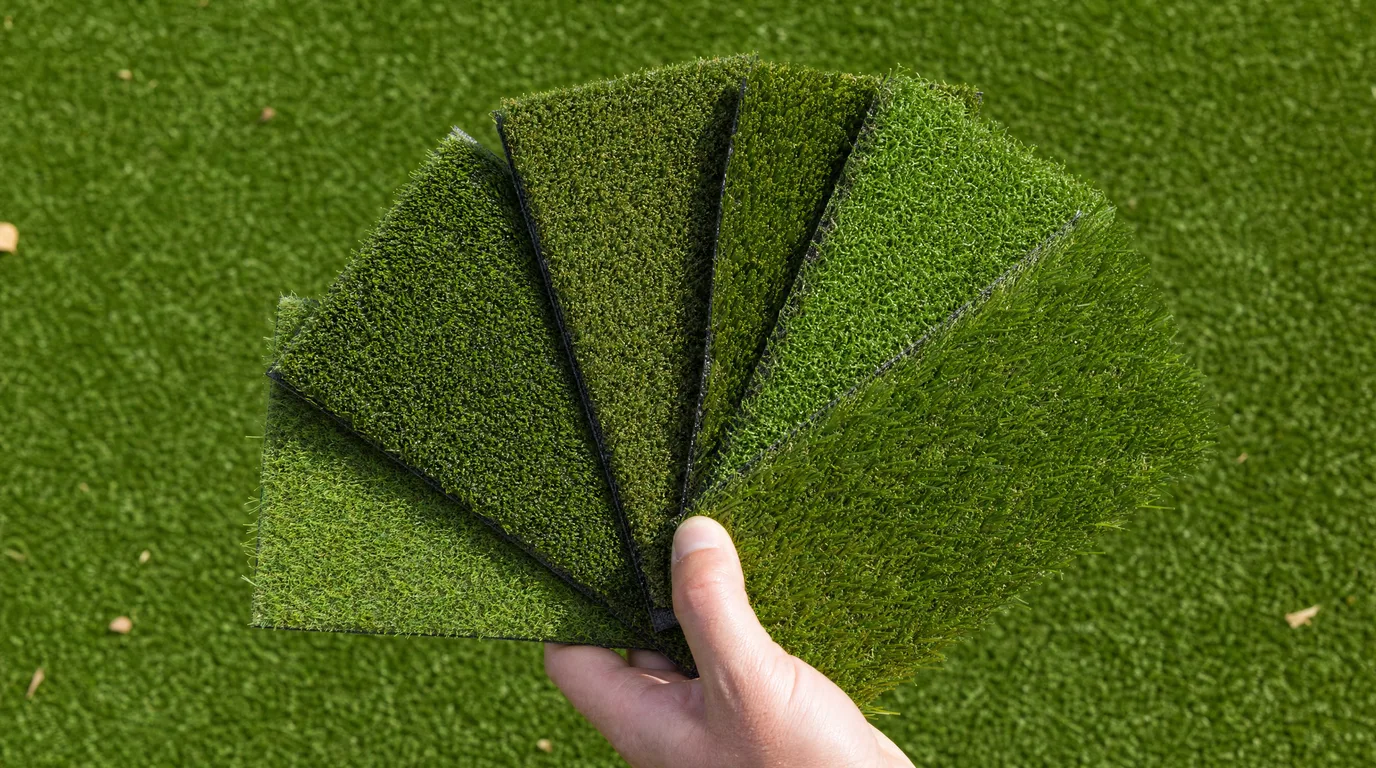
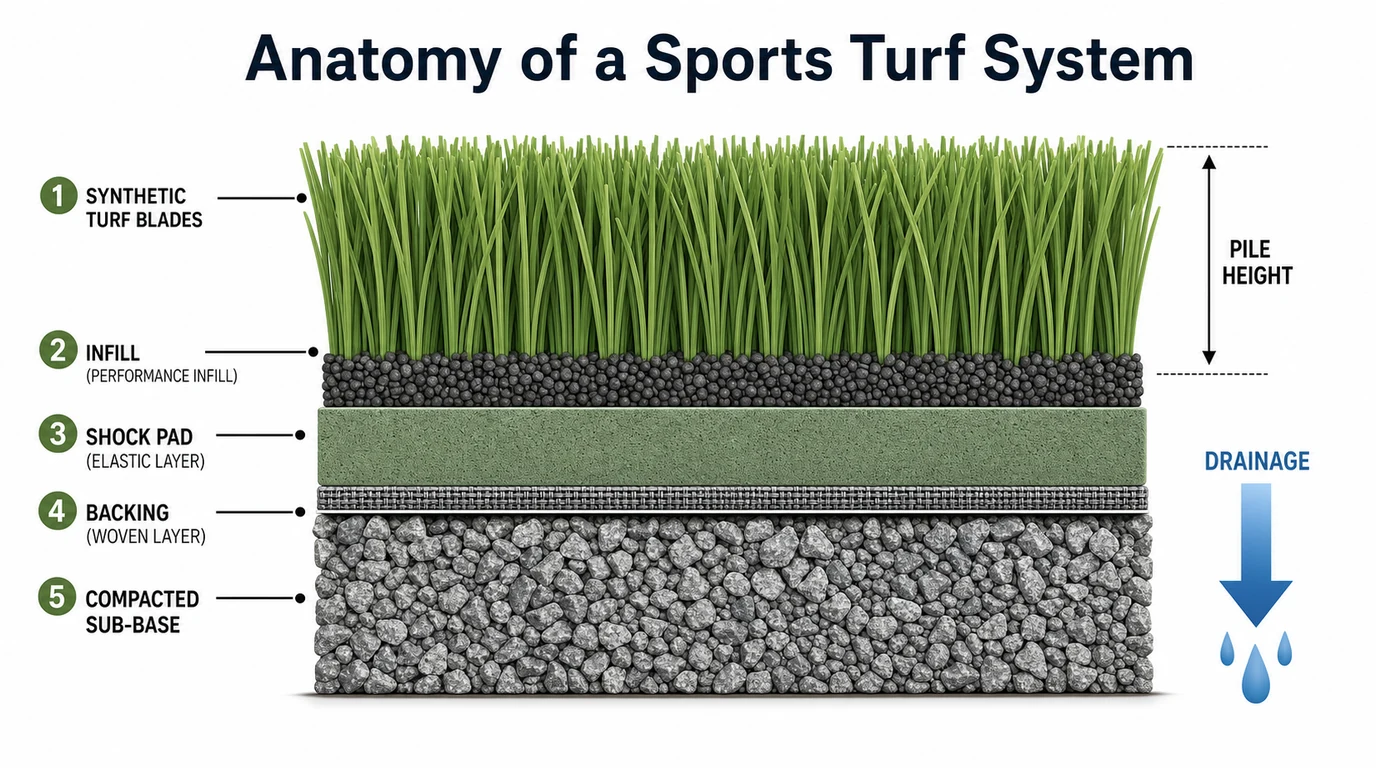
Pile height is the length of the blades above the backing, measured before infill goes in. It drives how the ball interacts with the surface, how traction feels in cleats, and how soft the field is underfoot. The right number depends almost entirely on what’s being played on it.
Soccer and football/soccer combos. A 2- to 2.25-inch pile is the sweet spot. It gives the ball enough surface contact for a realistic roll and gives players cushion so they aren’t planting into a hard surface. A lot of soccer installs in the Southwest run this range because it also handles the foot-strike volume of a travel club’s weekly schedule.
Football and lacrosse. Shorter pile — often 1.5 to 1.75 inches — is preferred. The stiffer surface gives football cleats better traction and lacrosse more consistent footing. Shorter pile also holds infill better, which keeps the field firmer underfoot. The Synthetic Turf Council publishes objective, non-proprietary guidelines on sports-field performance benchmarks if you want the third-party version of all this before you compare quotes.
Multi-sport courts and training surfaces. When a field has to serve as both a soccer surface and a court-style practice area, a compromise pile of about 1.5 inches with a tightly specified infill usually works best. You won’t perfectly optimize for either sport, but the field stays manageable across uses. It’s the minivan of sports turf: nobody’s first choice, everybody’s most practical one.
One thing that gets undersold in spec conversations is density. Two products at the same pile height can play very differently if one is tufted at a higher stitch rate. Densely packed blades hold their shape under cutting and pivoting far better than a thin, loose product. So when you compare quotes, ask for stitch rate alongside pile height — they’re not the same number, and the cheaper one usually skimps on the one you can’t see.
Infill: The Silent Performance Variable
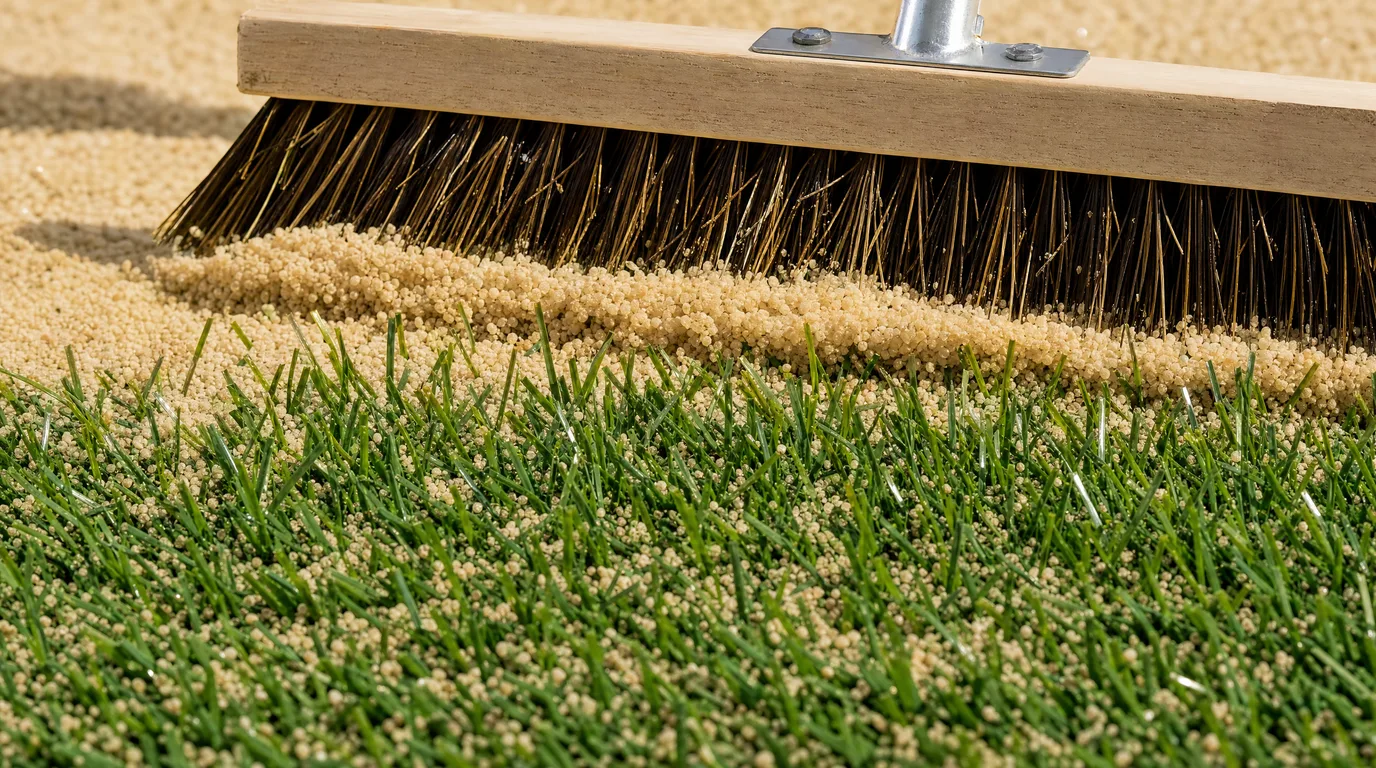
Infill is the material broadcast into the pile after install — sand, rubber, organic granules, or coated mineral. It stabilizes the fibers, adds cushion, and on a performance field it does real work in shock attenuation, ball rebound, and traction. The right turf infill for a field depends on the sport, the climate, and the budget.
Crumb rubber (SBR or EPDM) is the traditional sports infill. Good resilience, good shock absorption. It’s heavier and runs hotter than the alternatives, which matters more here than almost anywhere — an Arizona summer is not kind to a dark infill.
Silica sand is used alone in lower-cost systems or as a base layer under rubber. Firm, consistent, easy to top up. Good where a harder, faster surface is acceptable.
Sand-and-rubber blends are common on multi-use fields. The sand provides stability, the rubber adds give, and you can adjust the proportions to tune the feel.
Organic and coated-mineral infills run cooler than rubber and are increasingly specified for schools and parks with safety-focused purchasing policies. The cooling is meaningful out here — a south-facing field in July retains heat in any dark infill, and the cooler categories take the edge off.
Whatever you pick, infill depth has to be maintained. It migrates, compacts, and displaces over time, fastest in the high-traffic zones. Grooming and periodic top-ups aren’t optional extras; they’re part of keeping the field playing the way you paid for.
Shock Pads: When You Need One and Why
A shock pad is a foam or fiber underlayer installed between the compacted base and the turf backing. Its job is to drop the peak impact force a player feels in a fall or a tackle — the thing measured as a Gmax score. Lower is safer. Cornell’s sports field management program recommends keeping field hardness below a 150 Gmax level and testing for it periodically, and a pad is the most reliable way to stay under that line as a field ages.
For competitive play — organized league games, high school athletics, any contact sport — a shock pad is increasingly standard, and in many cases required by a governing body or a school district policy. Even for lower-level play, adding a pad is cheap insurance on an expensive field. On a multi-use field it also gives you a consistent base that makes the surface play more predictably across sports, and many pads let water pass through, which matters for drainage on fields that see rain.
In Arizona, a pad also buffers the thermal mass of a hot compacted base. It’s not a cooling solution — I won’t oversell it — but it adds a layer of separation between the base and the players, which on a 110-degree afternoon is not nothing.
Multi-Sport vs. Single-Sport: One Field or Many
The most common question we get from parks and schools: “Can we build one field for everything?” The honest answer is yes, with realistic expectations.
Single-sport fields can be dialed in precisely. A dedicated soccer field runs the fiber, pile, infill, and pad that high-level play demands. A football-only surface gets the traction profile and shorter pile coaches want. Purpose-built always plays best.
Multi-use fields are a compromise — a calculated one, not a cop-out. The most successful multi-sport specs we’ve worked with tend to do four things: run a mid-range 1.5- to 2-inch pile that doesn’t fully optimize for any one sport but doesn’t hurt any of them, choose a blended infill firm enough for football traction yet forgiving enough for soccer comfort, install a shock pad to cover the range of impact expectations across sports, and select a high face weight so the surface survives the combined wear of multiple teams.
If you’re managing a tight budget and limited field space, a multi-sport system with a quality base and a good, dense product is the right call — and you’re in good company. The NFHS has documented how schools are using multi-purpose synthetic fields to serve more teams and earn more revenue off one surface. If you have the space and the budget, dedicated fields will always outperform. Most committees land somewhere in the middle, which is exactly where the math usually wins.
Where Sports Turf Earns Its Keep
Sports turf isn’t only for full-size fields with painted lines. The same engineering — dense fiber, the right infill, a base that drains — shows up wherever play meets impact.
- Schools and parks running soccer, football, lacrosse, and field hockey on one programmed surface.
- Gyms and training facilities, where a turf-floored gym takes sled pushes and prowler runs without the wear a backyard product would show in a month.
- Batting cages and practice areas that need a firm, consistent surface and predictable ball behavior.
- Playgrounds and play areas, where the priority shifts to a forgiving, shock-attenuating surface that meets playground turf safety expectations rather than ball roll.
Different jobs, same principle: spec for the load, not the look.
| Sport / Use | What to Look For |
|---|---|
| Soccer | 2" to 2.25" pile, dense tufting, blended or rubber infill, shock pad for organized play |
| Football & lacrosse | 1.5" to 1.75" pile for traction, infill that stays firm, shock pad for contact |
| Multi-sport field | 1.5" to 2" mid-range pile, blended infill, high face weight, shock pad to cover the range |
| Gym & training floors | Short, dense pile that takes sleds and foot traffic; firm infill bed; durable backing |
| Batting cages / practice | Firm, consistent surface for predictable ball behavior; low pile; well-compacted base |
| Playgrounds | Forgiving, shock-attenuating surface and a pad; ball roll matters less than the fall |
Match the spec to the use. The base and drainage are non-negotiable across every row.
Drainage: The Foundation Nobody Brags About
Even the best turf system underperforms on a bad base. For a sports field, drainage isn’t a nice-to-have — standing water after rain delays play, erodes the base, and shoves infill around until the field is uneven. Nobody puts the sub-base in the brochure photo, but it’s the part doing the heaviest lifting.
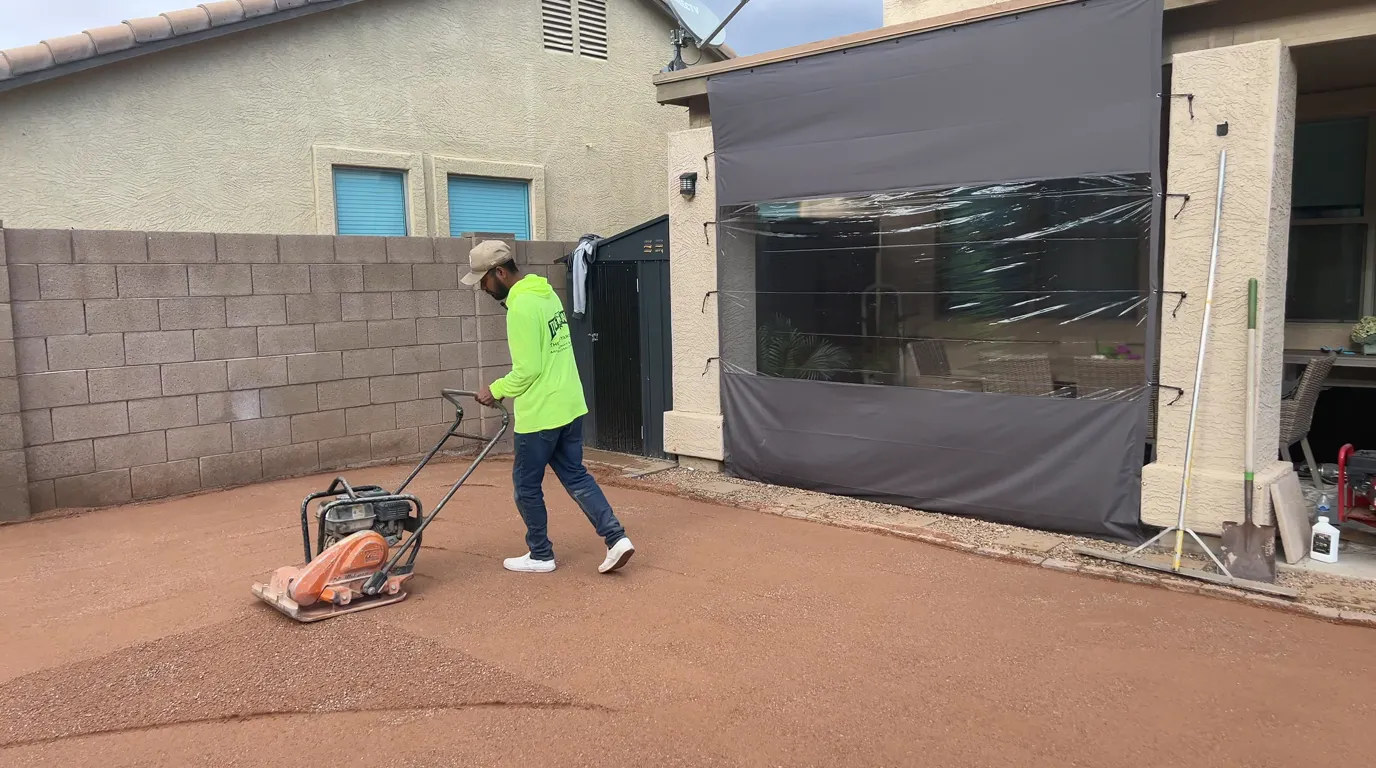
A well-designed field base uses a properly graded aggregate sub-base — usually decomposed granite or crushed stone — with a consistent fall to move water off quickly. The turf backing should carry a high-porosity perforation pattern to match. All our turf runs a double PP backing with a polyurethane coating and quadruple drainage holes, which is built to pass real runoff rather than pond on top of it.
Our sports turf installs use a carefully compacted base that holds up through the Arizona monsoon. Plan drainage into the spec from the start, not as a fix after the first storm finds the low spot for you. It always does.
Supply vs. Install: What You’re Actually Buying
Worth being clear about how we work, because the sports-field world is full of “installed” prices that bury the material cost. We’re a supplier first. We sell turf, base, and infill at contractor pricing — to everyone, whether you’re a district, a contractor, or a club running its own crew — and we deliver and offload across Arizona and Utah.
Here’s the part committees underestimate: the turf material is rarely the whole bill. The base, infill, shock pad, and installation typically add up to a cost comparable to the material itself. So when you budget, budget for the system. We’ll quote you the turf straight and tell you honestly what the base and infill add, so you can see what’s material and what’s everything else. If a crew is doing your install, great — we set them up to win. If you want install help, that’s the bonus, not the headline.
Size Up the Materials First
Enter your field dimensions and we'll help you estimate turf yardage, infill, and base — the numbers your planning committee actually needs.
Keeping a Field Performing
A sports field isn’t set-and-forget — turf is low-maintenance, not no-maintenance, and a field that sees daily play needs a real grooming program. The good news is it’s a fraction of the work a natural grass field demands. No mowing, no watering schedule, no reseeding the goalmouth every August.
The recurring jobs are grooming the fibers upright, redistributing and topping off infill where traffic has thinned it, and testing field hardness so the Gmax stays in a safe range as the surface ages. Stay on top of those and a well-installed field holds up for 8 to 15 years. Ignore them and a heavily programmed field wears out years early — the surface doesn’t fail all at once, it just quietly gets harder and flatter until somebody measures it and gets a number they don’t like.
Spec by Sport and Use, at a Glance
If you’re early in planning, bring this short checklist into any quote conversation and you’ll sound like you’ve done this before.
- Primary sport. What gets played here most? That sets pile height and infill.
- Annual hours of use. Practice-only and occasional community use is a lighter load than daily multi-team play. Heavier use means a denser product and a higher face weight.
- Governing body or policy requirements. Does the league or district require a specific Gmax rating? If so, you almost certainly need a shock pad.
- Climate exposure. In Arizona and Utah, UV and heat retention shape infill choice and expected lifespan. Cooler infill earns its keep on a south-facing field.
- Whole-system budget. Base, infill, pad, and install run comparable to the turf itself. Plan for the system, not the roll.
Skimping on the Base
The single most expensive mistake. A bad sub-base means standing water, erosion, and uneven infill — and no fiber spec saves a field that ponds after every storm. Spend here first.
Wrong Pile for the Traffic
A light-use landscaping product under daily multi-team play mats down and loses its springback fast. Match face weight and density to the real hours of use, not the brochure.
Cheaping Out on Infill
Infill does the quiet work — stability, cushion, shock, traction. The wrong or too-thin infill makes a good product play badly, and it migrates and compacts, so plan for top-ups.
Treating Drainage as an Afterthought
Drainage belongs in the spec from day one, not as a fix after the first monsoon finds your low spot. Grade the base and match the backing's perforation to the runoff.
Spec'ing a Field? Let's Talk Numbers.
We'll walk through your sport, traffic, and budget, and quote turf, base, and infill straight — for districts, contractors, and clubs across Arizona and Utah.
- 4.9 from 300+ reviews
- 12-year manufacturer warranty
- Free quote & free sample
- Arizona & Utah
What Customers Say
5.0 from 480+ verified Google reviews
Have you yearned for the old days when personality and convenience meant the most of which business you frequent ? When reputation began with a handshake and a working relationship went beyond a cold and impersonal website or an AI chat box. The Turf Yard provided a caring, supportive and interactive experience with my turf needs. The best price and making sure at the end of the day, you were beyond satisfied. (And hoping for the opportunity to refer them to other prospective turf buyers) I highly recommend their company for your turf needs - big or small.
Best customer service I have ever had! They respond super fast to messages and they worked out a way for my turf to be delivered the same day. Bennett reached out to me and let me know when he was on his way to my home. So easy to work with! If you need turf you can 100% trust them to help you!!
Expert Tips
— Bennett Brown, Co-Founder
Spec the Base Before the Fiber
I know the turf is the fun part. But the sub-base decides whether your field lasts 8 years or 15. Grade it, compact it, and plan the drainage before you fall in love with a pile height.
Ask for Stitch Rate, Not Just Pile
Two products at the same pile height can play completely differently. Density is what holds the surface together under cutting and pivoting. Get the stitch rate on the quote and compare apples to apples.
Match Pile to the Primary Sport
2 to 2.25 inches for soccer, 1.5 to 1.75 for football and lacrosse. Pick the sport that runs the most hours and spec for it. A multi-sport field splits the difference at a mid-range pile.
Pick a Cooler Infill in Arizona
A dark crumb-rubber field in July holds heat. If your field faces south and the budget allows, a cooler organic or coated-mineral infill takes the edge off for the players.
Don't Skip the Shock Pad on Contact Fields
For youth and contact sports, a pad is cheap insurance on an expensive field — and often required. It keeps the Gmax in a safe range as the surface ages.
Budget for the Whole System
Base, infill, pad, and install run comparable to the turf material. If a committee only budgets for the roll, they're budgeting for half a field. Plan for all of it up front.
— Bennett Brown, Co-Founder
Related Services
We supply the turf, base, and infill — and the straight answers on athletic specs — across the Arizona service area from our Mesa yard and across Utah from Provo, with free samples and hands-on guidance for districts, contractors, and clubs. Bring us your dimensions, your primary sport, and your use schedule, and we’ll help you spec the system and price it honestly. Call Mesa at (480) 910-2440 or Provo at (385) 335-9042. We’ll quote you the turf, the base, and the infill straight — and the only thing we mark up is the bad jokes, which are still free.