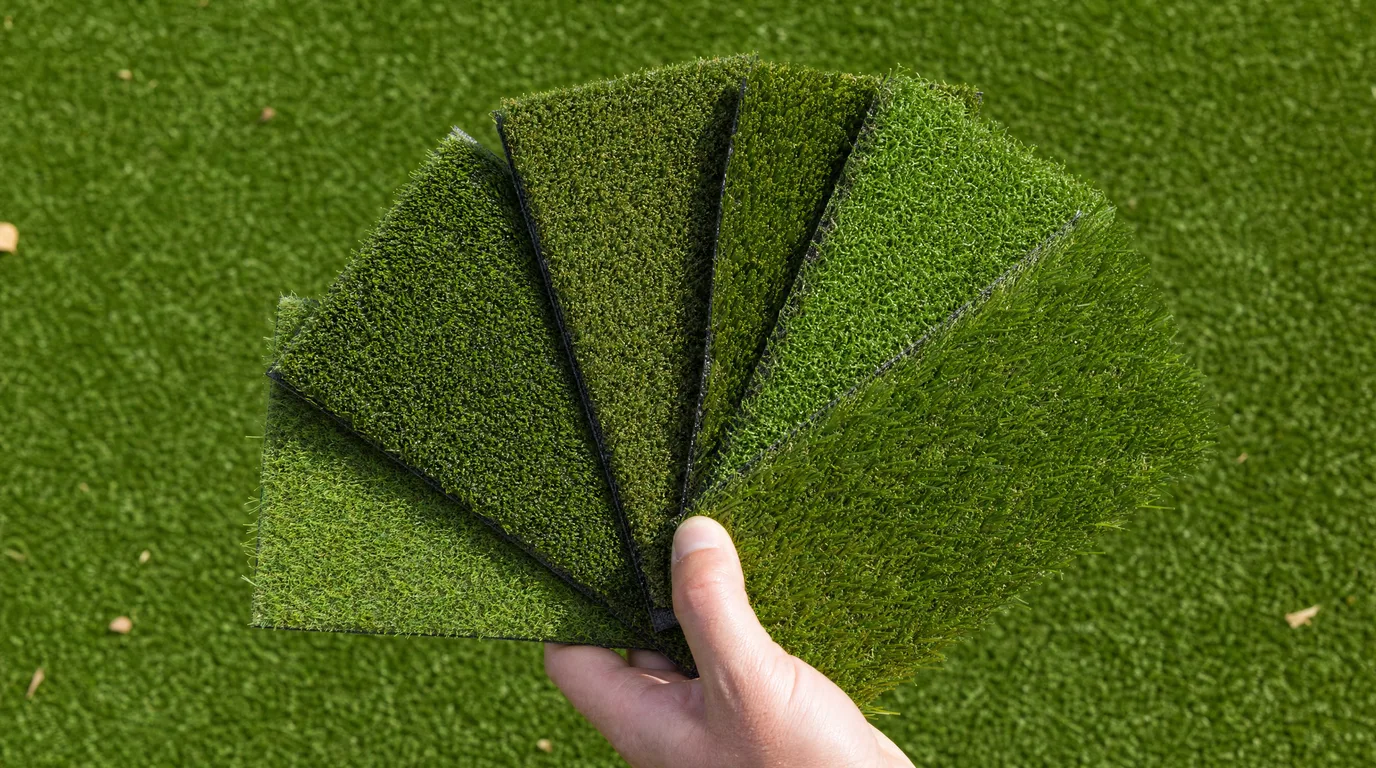
Spec sheets make every roll of artificial grass sound identical. Same words, same UV-stabilized this, same drainage that, all of it green. So how to choose artificial grass rarely comes down to the spec sheet — it comes down to matching the roll to what your yard actually does all day. That’s the part the marketing copy leaves out.
I’ve handed a few hundred people a sample over the counter, and the conversation is almost always the same five things: how tall the blade is, what shape it is, how the backing drains, what the yard is for, and what you want to spend. Get those right and the “best” turf picks itself. Get talked into the biggest number on the page and you’ve paid for a putting green’s density to watch a dog run flatten it. And once you’ve picked the roll, the two follow-on calls that matter most are how to install it without botching the base and how long it’ll actually last once it’s down.
TL;DR — Quick Answer
Choosing artificial grass comes down to five things, in this order: pile height, blade shape, backing and drainage, what the yard is actually for, and budget. Match the roll to the use — a W-Blade around 1.5 inches handles most backyards and pets, while the plush C-Blade Lush Primo is for curb appeal over traffic. The biggest spec isn't the best spec; the right one is.
Five specs that matter
Pile, blade, backing, use, budget
Most popular pick
Lush 80 — 1.58" W-Blade
Price range
$1.19 to $1.89 per sq ft
Biggest mistake
Buying the heaviest roll on the page
Not Sure Which Roll Is Right for Your Yard?
Tell us the size, the use, and the soil — we'll point you to the right roll and send a free sample. No pressure, no obligation.
Table of Contents
Key Takeaways
- Pile height, blade shape, backing, use case, and budget are the five things that decide the right roll — read those, ignore the marketing adjectives.
- A W-Blade (Lush 70, Lucky 77, Lush 80) sheds heat and stands up to traffic; the C-Blade Lush Primo is softer and plusher, built for curb appeal over a busy yard.
- Around 1.5 inches of pile looks the most natural in a backyard — the Lush 80 at 1.58 inches is the popular middle ground for a reason.
- Every roll we stock uses UV-stabilized polyethylene blades and a PU backing with quadruple drainage holes, so the desert and the monsoon are both handled.
- The biggest number on the spec sheet is rarely the right answer — match the roll to the traffic, not to the brochure.
Why Every Spec Sheet Sounds the Same
Here’s the uncomfortable truth from the supply side: most turf spec sheets are written to sound impressive, not to help you decide. They all claim UV stabilization. They all promise drainage. They all photograph beautifully on a cloudy day with the sun behind the photographer.
The fix isn’t a better spec sheet — it’s knowing which five numbers actually change how the turf behaves in your yard. Pile height. Blade shape. Backing and drainage. The use case. The budget. The Synthetic Turf Council publishes industry guidelines on exactly these system elements if you want the long version. The rest of this post is the yard-counter version.
Pile Height: How Tall the Blade Stands
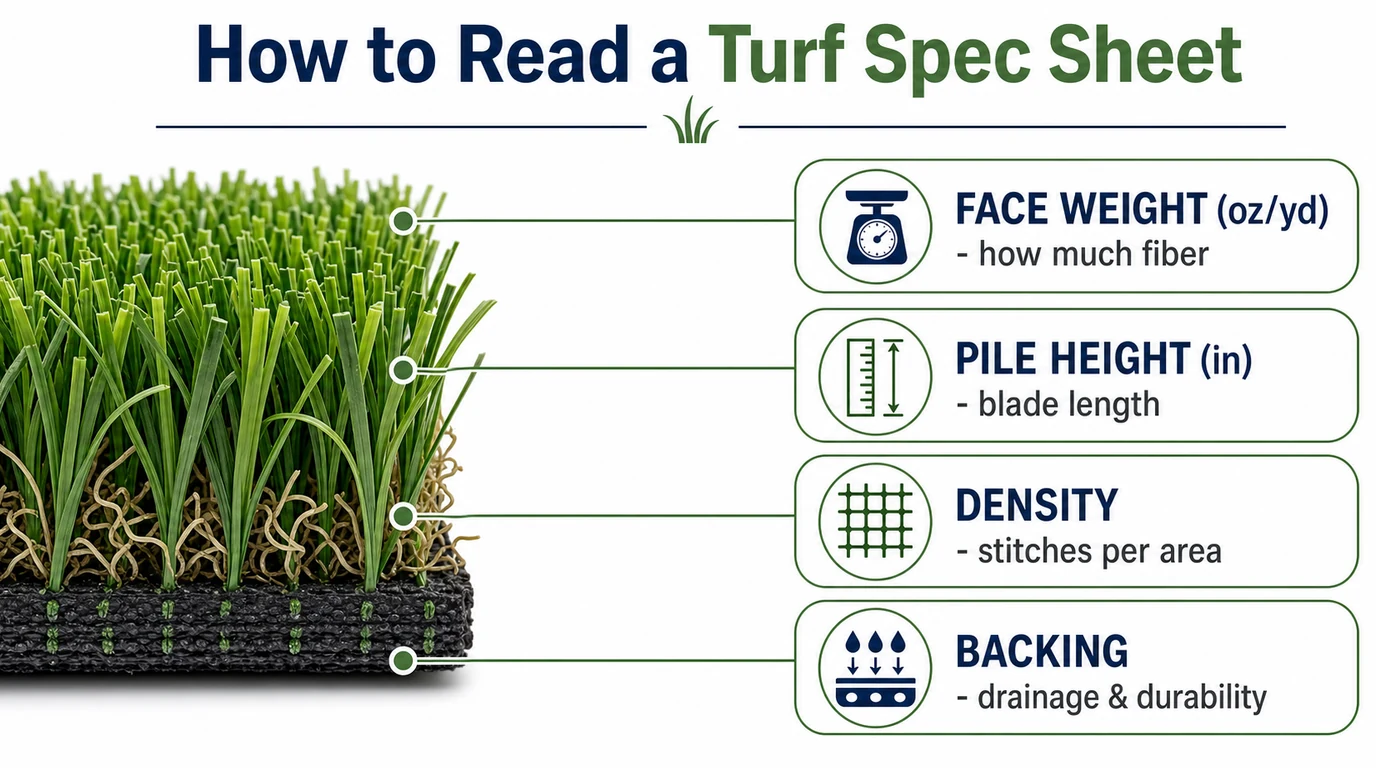
Pile height is the length of the blade from the backing to the tip, measured in inches. It’s the spec people fixate on first, usually because taller sounds plusher and plusher sounds better. Sometimes it is. Often it isn’t.
For most backyard lawn replacements, somewhere around 1.5 inches looks the most natural and is the easiest to live with. Our Lush 70 sits at 1.38 inches — short, tidy, and budget-friendly. The Lucky 77 is 1.5 inches, the Lush 80 is 1.58 inches, and the Lush Primo tops out at 1.77 inches.
Taller pile feels luxurious in the showroom and then mats down in the lanes that get the most foot traffic if you don’t brush it. Think of pile height like a haircut — longer looks great until it’s the only thing you have to maintain. For a kids-and-dogs backyard, the middle of that range is the sweet spot. For pure curb appeal out front, the taller Primo earns its keep.
Blade Shape: W-Blade vs C-Blade
This is the spec most buyers have never heard of, and it matters more than pile height. The shape of the individual yarn strand changes how the blade stands up, how it handles heat, and how it feels underfoot.
A W-Blade is shaped — exactly like it sounds — in a W cross-section. That extra structure helps it stand back up after you walk on it and helps it shed heat instead of holding it. It’s the workhorse. Three of our four rolls use it: the Lush 70, the Lucky 77, and the Lush 80.
A C-Blade curls into a softer C shape. It feels plusher and gives the best curb appeal, but that softness is also why it isn’t the pick for heavy traffic. We use the C-Blade on exactly one roll: the Lush Primo. It’s the looker of the lineup, a 100 oz blade with a 1.77-inch pile, built for the front yard you want the neighbors to notice — not the dog run that gets hammered daily.
Rule of thumb: W-Blade for the yard that gets used, C-Blade for the yard that gets admired. Cornell’s sports field management resources go deep on fiber construction if you want the agronomy behind it.
Backing and Drainage: The Part Nobody Photographs
The backing is what the blades are tufted through, and it’s what decides whether water moves through your turf or sits on top of it. Nobody puts the backing in the hero photo, which is exactly why it’s worth checking.
Every roll we stock uses a double PP backing with a polyurethane coating and quadruple drainage holes. That last part is the one that matters in Arizona. We don’t get much rain, but when the monsoon shows up it shows up all at once — and a backing that can’t move water fast enough backs up into standing puddles. Quadruple-hole drainage clears a hard desert downpour without complaint, and it handles a dog and a hose the same way.
When you’re comparing suppliers, ask flatly how the backing drains and how many drainage holes it has. If the answer is vague, that’s an answer too.
Start With What the Yard Is For
Here’s the question I ask first, before pile height or anything else: what does this patch of ground do all day?
- Kids and dogs. You want a W-Blade that stands back up and a backing that drains fast. Pair it with a good infill — for pet zones, a zeolite infill handles odor at the source the way plain sand never will.
- Pure curb appeal. Front yard, low traffic, you want it to look like a magazine cover. This is where the plush C-Blade Lush Primo earns the extra dollars.
- Budget lawn replacement. A side yard or a smaller area where you want green grass without overthinking it. The Lush 70 at $1.19 a square foot does the job.
- Most backyards, doing a bit of everything. This is the big middle, and it’s why the Lush 80 outsells everything else.
The University of Florida’s extension service has a level-headed homeowner guide to synthetic turf worth a read before you commit — it’s the neutral, non-salesy take on what turf does and doesn’t do.
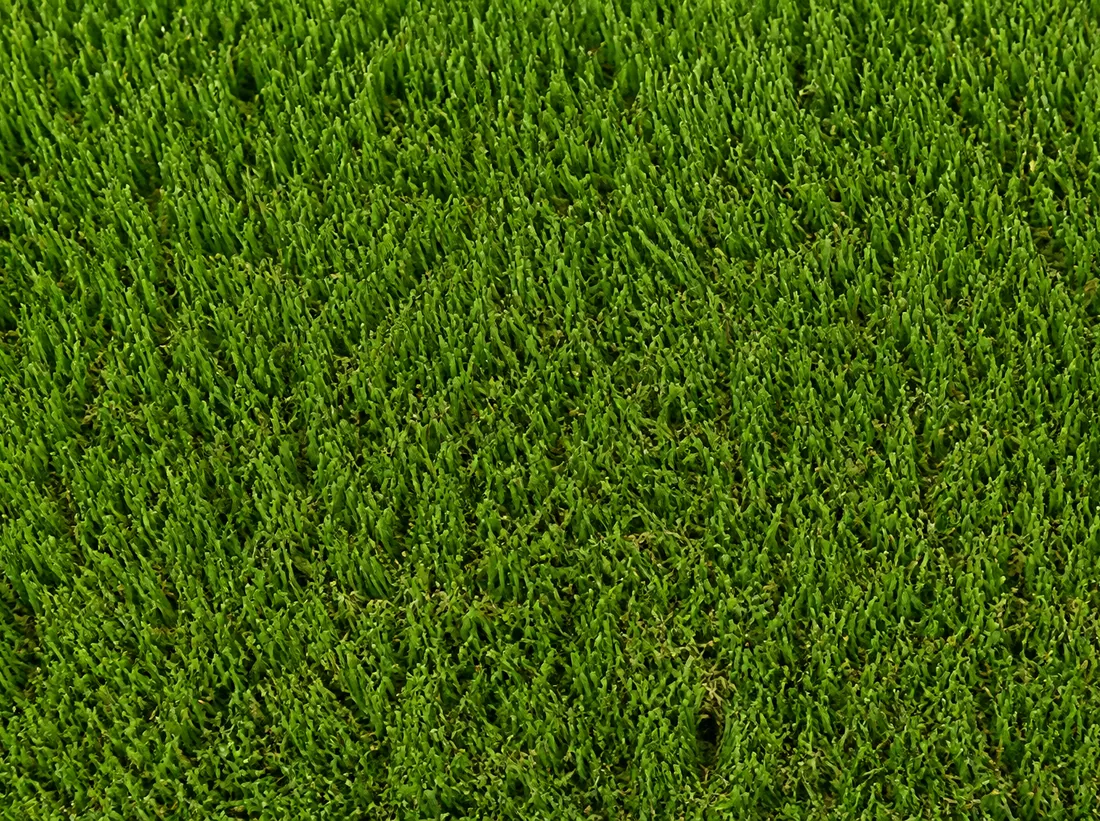
Lush 80 Artificial Turf
A premium, realistic turf with a fuller feel. A balanced fit for lawns, pets, and active yards.
View Lush 80 →Budget: The Yard Price, Plainly
Most turf gets sold to homeowners buried inside an “installed” price, marked up three or four times over what the material actually costs. We started The Turf Yard in 2019 specifically because that bugged us. So here’s the yard price, plainly, contractor pricing for everyone:
- Lush 70 — $1.19 a square foot
- Lucky 77 — $1.39 a square foot
- Lush 80 — $1.56 a square foot
- Lush Primo — $1.89 a square foot
Those numbers are the same in Arizona and Utah. Only accessories, infill, and delivery run a little higher up in Provo. The cheapest roll per square foot isn’t always the cheapest project — but it’s a lot easier to do that math when nobody’s hiding the material cost from you in the first place.
Before you talk numbers with anyone, run your square footage through our turf calculator. It works out turf yardage, base, and infill in one go, so there are no surprises when the truck shows up.
The Four Rolls, Side by Side
To make this concrete, here’s how our four rolls actually compare — real specs, not adjectives.
| Roll | Pile Height | Blade | Roll Width | Best For | Price /sq ft |
|---|---|---|---|---|---|
| Lush 70 | 1.38" | W-Blade | 12 ft | Budget-friendly, entry-level installs | $1.19 |
| Lucky 77 | 1.5" | W-Blade | 15 ft | Customers wanting the darkest green | $1.39 |
| Lush 80 | 1.58" | W-Blade | 15 ft | Most popular middle-ground option | $1.56 |
| Lush Primo | 1.77" (100 oz) | C-Blade | 15 ft | Premium — thickest, softest, best curb appeal | $1.89 |
All four use UV-stabilized polyethylene blades, multi-tone color with a thatch layer, and a PU backing with quadruple drainage holes. The right roll is the one that fits the use, not the one with the biggest number.
Every one of those rolls cuts to length up to 100 feet, runs kid- and pet-friendly, and carries the same 12-year manufacturer warranty. The differences that matter are the ones in the table — and the one you can only judge by holding a sample in your own afternoon light.
Buying Traps to Avoid
I’ve watched a lot of people talk themselves into the wrong roll. It’s almost always one of these three.
Chasing the Biggest Number
The thickest, heaviest roll is built for curb appeal, not a dog run. A 100 oz C-Blade Primo in a high-traffic play zone mats down faster than a W-Blade matched to the job. Bigger isn't tougher.
Ignoring the Traffic
Picking turf by how it looks in a photo, with no thought to what the yard actually does. Kids and dogs need a W-Blade and fast drainage. The prettiest blade in the wrong spot is the one you'll replace early.
Over-Buying the Area
Guessing the square footage high 'to be safe' and paying for rolls you'll never lay. Run the calculator first. It works out yardage, base, and infill so you buy what the project needs, not what padding your estimate costs.
Stick to matching the roll to the use, and order what the calculator says, and you’ll skip every one of these.
Tell Us What the Yard Is For — We'll Match the Roll
Size, use, soil, and budget. Give us those four and we'll point you to the right roll and send a free sample, for homeowners and contractors across Arizona and Utah.
- 4.9 from 300+ reviews
- 12-year manufacturer warranty
- Free quote & free sample
- Arizona & Utah
What Customers Say
5.0 from 480+ verified Google reviews
The team was fast to give me good pricing on quality turf. They organized a deliver for me in Tucson. Special thanks to Tia, Haley and Bennett for helping me with the purchase, so I could complete my project before Christmas.
The Turf Yard saved me thousands! I wanted to DIY my turf and had been quoted thousands more by another company that didn't even deliver. I got lucky and found The Turf Yard on an online post. I got their Primo Lush and love it! They delivered to my backyard when I was ready and even helped me position the turf so I could easily roll it out for install, since I was doing everything myself. They also helped by supplying me the infill and nails at a much lower cost. I love my turf so much I'm thinking about getting into the business! You're basically missing out if you don't reach out to them. Thank you!
Expert Tips
— Bennett Brown, Co-Founder
Get a Sample in Your Own Light
Green looks different in a showroom than in a 4 p.m. Arizona backyard. Hold the sample in the light it'll actually live in before you decide — it settles more arguments than any spec sheet.
Match the Blade to the Traffic
W-Blade for the yard that gets used — kids, dogs, parties. C-Blade Primo for the front yard you want to show off. Don't put the looker where the action is.
Around 1.5 Inches Is the Backyard Sweet Spot
Tall pile feels great in the showroom and mats in the traffic lanes. The Lush 80 at 1.58 inches hits the natural look without the upkeep of a deep pile.
Check the Drainage Before You Buy
Quadruple drainage holes are what clear a monsoon downpour and a hose. If a supplier can't tell you how the backing drains, that's your answer.
The Yard Price Is the Real Price
Material cost is always available separately from install — that's the whole reason we exist. If someone will only quote you 'installed', ask what the turf itself costs.
Run the Calculator First
It does turf, base, and infill in one pass. You'll buy what the job needs instead of padding the order 'to be safe' and paying for rolls you never lay.
— Bennett Brown, Co-Founder
Related Services
How to Pick a Turf Supplier
Choosing the roll is half of it. Choosing who you buy it from is the other half, and the rule is short: pick the supplier who’ll hand you a free sample, explain a W-Blade from a C-Blade without jargon, stock both DIY and contractor quantities locally, and quote you the material on its own. We supply turf, base, and infill across the Arizona service area from our Mesa yard and across Utah from Provo — no cross-country freight, and you’re welcome to come look at the rolls in person. Swing by, grab a sample, and call Mesa at (480) 910-2440 or Provo at (385) 335-9042. We’ll help you pick it, price it, and load it — and we’ll only talk you out of the expensive roll if it’s the wrong one for your yard, which, honestly, is half the fun.