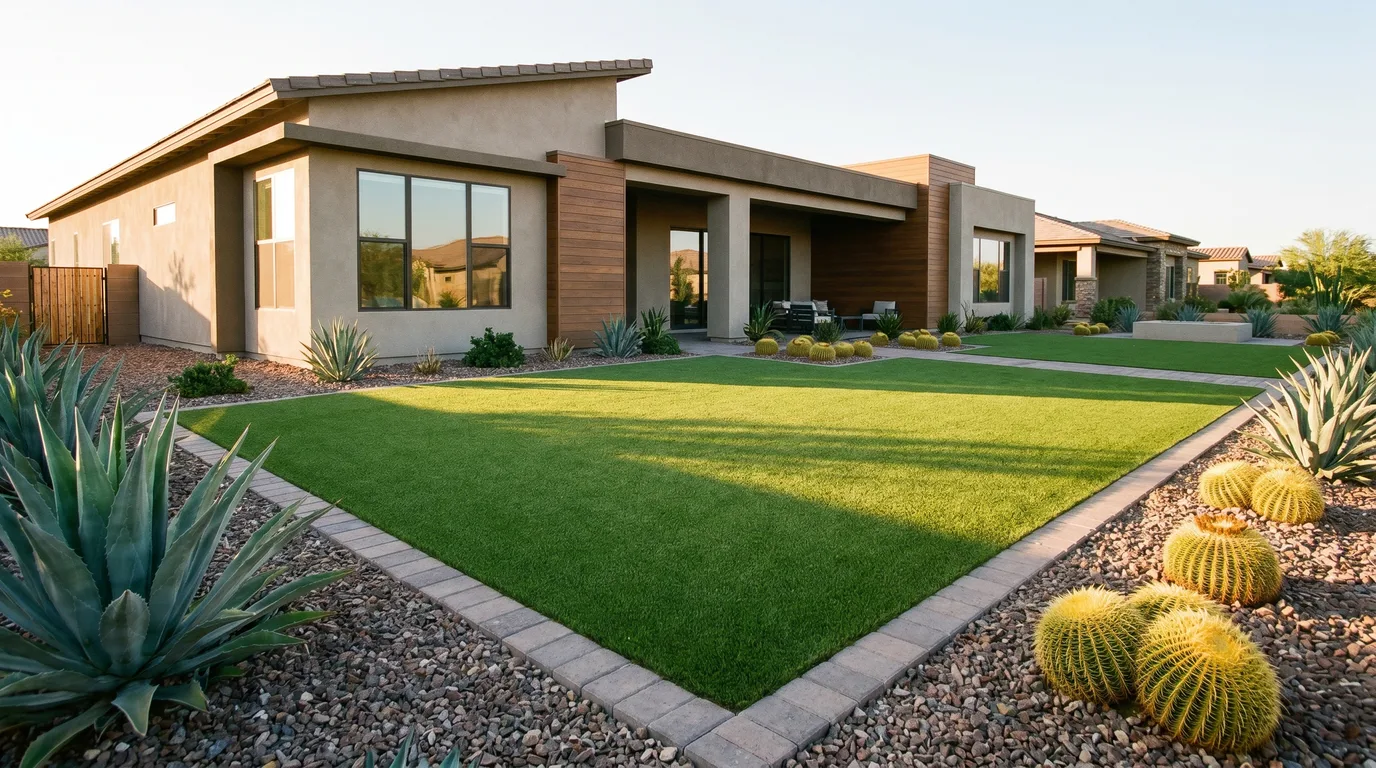
I sell artificial turf for a living, which makes me the wrong person to ask if you want a one-sided answer. So here’s the deal I’ll make instead: the honest pros and cons of artificial turf, including the parts that cost me a sale. Turf is a genuinely good call for a lot of yards across Arizona and Utah. It’s also the wrong call for some of them, and I’d rather say so now than sell you a roll you’ll resent by August. Let’s run both columns.
TL;DR — Quick Answer
The biggest pros of artificial turf are no watering, no mowing, and a green, mud-free yard year-round — which matters most where sprinklers get restricted half the summer. The honest cons are a higher upfront cost, a surface that runs hot in full sun, and a 10-to-15-year lifespan before replacement. It's a strong fit for water-hungry yards, pet runs, and shady dead spots, and a poor fit if you want a barefoot lawn in July with no infill.
Biggest pro
No water, no mowing
Biggest con
Upfront cost and heat
Lifespan
10 to 15 years
Best for
Dogs, drought, dead spots
Weighing It For Your Own Yard?
Tell us your square footage and what the space is for. We'll give you a straight read on whether turf is the right call — and what the material actually costs.
Table of Contents
Key Takeaways
- The strongest case for turf is water — it needs zero irrigation, the single biggest line on most Arizona summer water bills.
- The honest knock is heat. Dark turf in full sun runs hot, and the fix is a cooling infill and a quick rinse, not a marketing claim.
- Turf costs more upfront than sod but removes years of water, mowing, and reseeding — whether it pays back depends on your water bill and how long you stay.
- It lasts 10 to 15 years, it's a plastic product, and it isn't as soft as a living lawn. Buy it for the right reasons and spec the base and infill properly.
The Pros of Artificial Turf
The case for turf is strongest where a real lawn struggles, which is most of the desert Southwest.
It needs no irrigation. This is the big one. In Phoenix, where it rains fewer than eight inches a year, a real lawn lives almost entirely on your sprinklers. Turf needs none of that, so the largest discretionary line on your summer water bill simply disappears. Arizona and Utah both run grass-removal rebates because of exactly this, and you can read the case for cutting outdoor water use straight from the regional conservation program Water Use It Wisely — which, to their credit, also lists the reasons turf might not suit you. We dig into the savings math in our guide to artificial turf and water conservation.
It’s low-maintenance — not maintenance-free. No mowing, no fertilizing, no reseeding the dead patch by the dog’s favorite corner. What it does want is an occasional rinse and a cross-brush in the traffic lanes. That’s a Saturday-morning rounding error next to running a mower and a sprinkler timer all summer. Anyone who tells you turf is zero upkeep is the same person who’ll sell you the cheapest roll on the rack.
It stays green and mud-free year-round. No brown dormant season, no muddy paw prints tracked across the kitchen after a monsoon, no ruts where the kids cut the same corner every day. For pet-friendly turf and play areas, the mud thing alone sells a lot of yards. It drains fast, dries fast, and doesn’t get dug up the way sod does.
It’s durable and predictable. A good landscape turf takes heavy foot traffic without wearing into dirt tracks, and our products carry a 12-year manufacturer warranty. You know what the yard will look like in February and in July, which a living lawn can’t promise in a drought year.
The Cons of Artificial Turf
Now the column that costs me sales. These are real, and pretending otherwise is how people end up disappointed.
The upfront cost is higher than sod. No way around it — you’re buying a manufactured product plus a proper base instead of a pallet of grass. The thing most people don’t realize is that you don’t have to pay an installed markup to get it. The turf itself runs $1.19 to $1.89 a square foot at our yard, contractor pricing for everyone, and you can buy the material on its own and do the base yourself. The full breakdown lives in our artificial turf cost guide, and the turf calculator will price your exact square footage.
It gets hot in direct sun. Dark turf in full July sun can hit 140 to 170 degrees — so can your driveway, your patio pavers, and the bare dirt next to a dead lawn, but it’s a fair knock. The honest fix is a heat-reducing blade shape, a lighter cooling infill, and a 60-second rinse that drops the surface temperature fast. University research backs up that the heat is real and use-dependent; the University of Illinois Extension covers it plainly. We wrote a whole piece on whether artificial turf gets too hot because it’s the question we get most.
It’s plastic, and it doesn’t last forever. Turf is a petroleum product, it isn’t biodegradable, and a residential lawn lasts about 10 to 15 years before it needs replacing. That’s the genuine environmental trade-off against the water you save, and it’s a real one — even the New York Times’ Wirecutter declines to recommend it for most lawns on those grounds. I won’t pretend that away. What I’ll say is that the lifespan is long, the warranty is 12 years, and the water it saves over that life is substantial — read how long artificial turf lasts for the full picture.
It isn’t as soft as a living lawn, and the base has to be right. Turf over a firm base has give, but it’s firmer than grass, and on a bad base it wrinkles and pools. Most of the failed installs I’ve seen weren’t bad turf — they were a skipped base step. In Arizona that means digging through caliche; in Utah it means drainage built for freeze-thaw.
Artificial Turf vs Natural Grass at a Glance
Here’s the quick side-by-side. Real numbers, no thumb on the scale.
| Artificial Turf | Natural Grass | |
|---|---|---|
| Upfront cost | Higher (material + base) | Lower (sod or seed) |
| Ongoing cost | Near zero | Water, mowing, fertilizer, reseeding |
| Water use | None | High — the bulk of a summer bill |
| Maintenance | Rinse and cross-brush | Weekly mowing and watering |
| Lifespan | 10 to 15 years | Indefinite, if it survives the summer |
| Heat in full sun | Runs hot; infill and rinse help | Cooler |
| Feel underfoot | Firm, mud-free | Soft, can be muddy |
A general comparison for a hot, dry climate. Your numbers shift with yard size, water rates, and how the space gets used.
Is Artificial Turf Worth It?
The honest answer is that it depends on two things: your water bill and how long you’ll stay. Turf’s payback comes from years of saved water and mowing, so the longer you keep it, the better the math. If you’re selling in two years, it’s a closer call.
It’s a strong fit if you have a water-hungry yard in a drought-restricted area, a dog that turns grass to mud, a shady or high-traffic spot where nothing will grow, or you’ve simply had it with the mower. It’s a weak fit if you want a soft barefoot lawn in full July sun and won’t run a cooling infill, you want a living ecosystem for pollinators, or you have a large easy lawn that already grows well on little water. We lay the full money case out in sod vs artificial turf, and residential turf covers the home-lawn side.
Believing 'maintenance-free'
Turf is low-maintenance, not no-maintenance. It wants a rinse and a cross-brush. Anyone promising zero upkeep is overselling.
Skipping the cooling infill
The infill is what manages heat and pet odor. Cheaping out here is where most 'turf is too hot' complaints come from.
Cutting the base short
A weak base is the number one cause of wrinkles, pooling, and early failure. Spend the time and aggregate here.
Buying installed-only
Plenty of yards only quote a marked-up installed price. The material is always available on its own — ask what the turf itself costs.
Not Sure It's Right For Your Yard?
We'll give you the honest read, the material price on its own, and a free sample to hold in your own light.
- 4.9 from 300+ reviews
- 12-year manufacturer warranty
- Arizona & Utah
What Customers Say
5.0 from 480+ verified Google reviews
Best customer service I have ever had! They respond super fast to messages and they worked out a way for my turf to be delivered the same day. Bennett reached out to me and let me know when he was on his way to my home. So easy to work with! If you need turf you can 100% trust them to help you!!
I’m a FLOORING CONTRACTOR and the quality of material that I purchased here was excellent and the price was great. I do appreciate the quality and the timely on the delivery. Everything turned out great thank you.
Expert Tips
— Bennett Brown, Co-Founder
Price the Material First
Before you weigh any pro or con, get the turf price on its own. At $1.19 to $1.89 a square foot, the cost con looks very different than an installed-only quote makes it look.
Match the Roll to the Use
A W-Blade around 1.5 inches handles a real backyard with kids and dogs. The plush C-Blade Lush Primo is for curb appeal over traffic, not a dog run.
Spend on Infill and Base, Not Just the Roll
The two cons people complain about most — heat and a lawn that fails early — both come down to infill and base, not the turf itself.
Get a Sample in Your Own Light
Green looks different in a showroom than in a 4 p.m. Arizona backyard. Hold the sample where it'll actually live before you commit.
Be Honest About How Long You'll Stay
Turf's payback is a slow burn over 10-plus years. If you're moving soon, the pros and cons tilt — say so and we'll tell you straight.
— Bennett Brown, Co-Founder
Related Services
So that’s both columns, the ones that help me and the ones that don’t. We supply turf, base, and infill across the Arizona service area from our Mesa yard and across Utah from Provo — contractor pricing for everyone, material always available on its own. Swing by, grab a sample, and call Mesa at (480) 910-2440 or Provo at (385) 335-9042. We’ll tell you the pros, the cons, and which one your yard actually lands on — even when the honest answer is “keep the grass.”