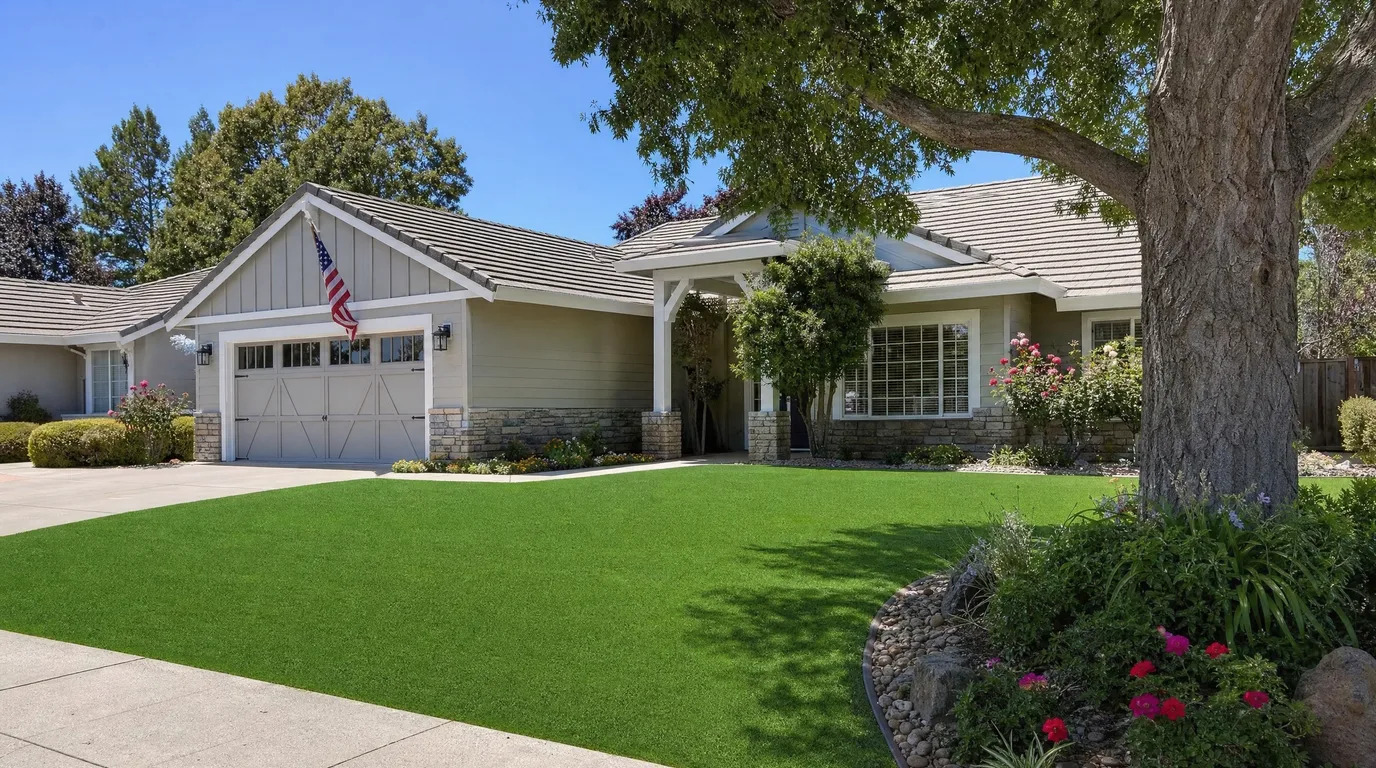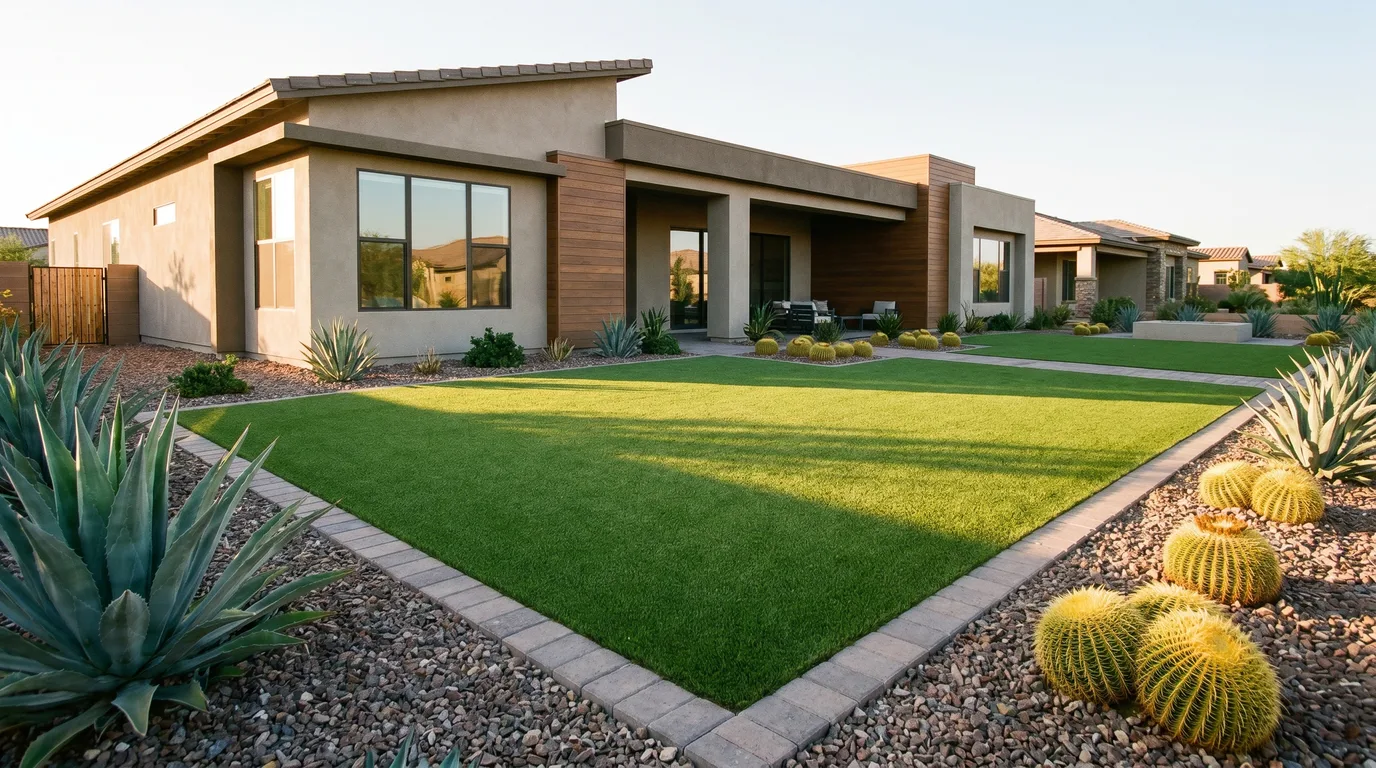
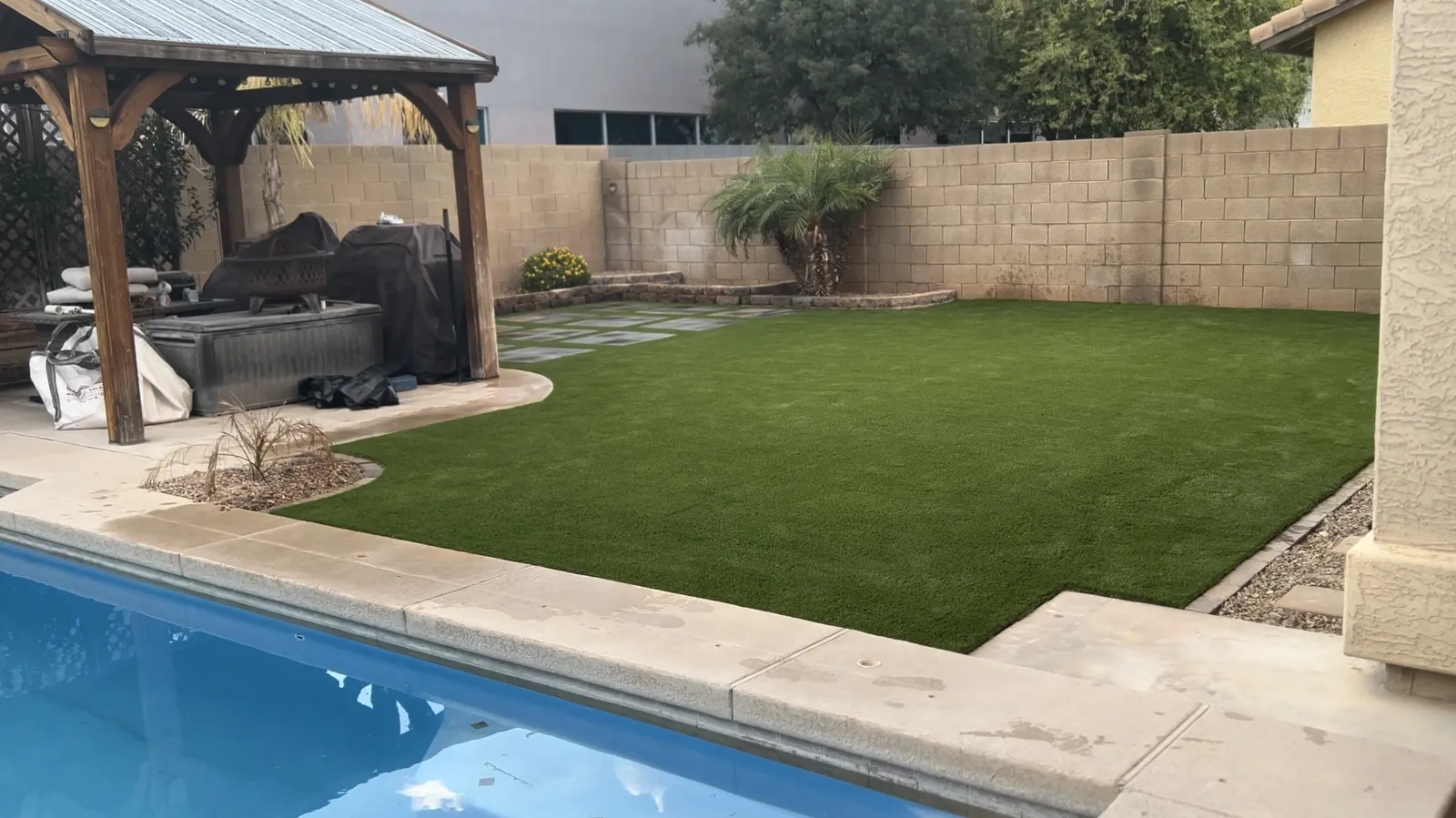
I liked having a lawn. I liked cutting it, even. That’s the part people don’t expect to hear from someone who tore his out.
The mowing wasn’t the problem. The problem was everything that came before the mowing. Every spring I’d be out back trying to figure out why one patch was brown and another corner was yellow and why there were clovers all over the yard. Some years I’d actually dig in and try to fix it. Other years I’d already be tired of the hassle and I’d just throw some seed down, hope for the best, and call it a summer.
Two years ago I put in artificial turf. This article is the honest artificial turf vs sod comparison I wish I’d had before I made that call.
TL;DR — Quick Answer
If you live in the Valley, have kids or pets, water with city water, and you're planning to stay in your house four or more years, artificial turf is probably the move — the cost math flips in turf's favor around year four. If you have a small shaded yard and you genuinely enjoy lawn care, sod is fine. The full case, including the situations where I'd still pick sod, is below.
Cost break-even
~Year 4
Sod water use
~50,000 gal/yr
Turf lifespan
15–20+ years
Best for
Kids, pets, 4+ yr stay
Thinking About Making the Switch?
Tell us your square footage and what your yard is for. We'll give you an honest side-by-side on sod vs turf — and the material price straight, no pressure.
Table of Contents
Key Takeaways
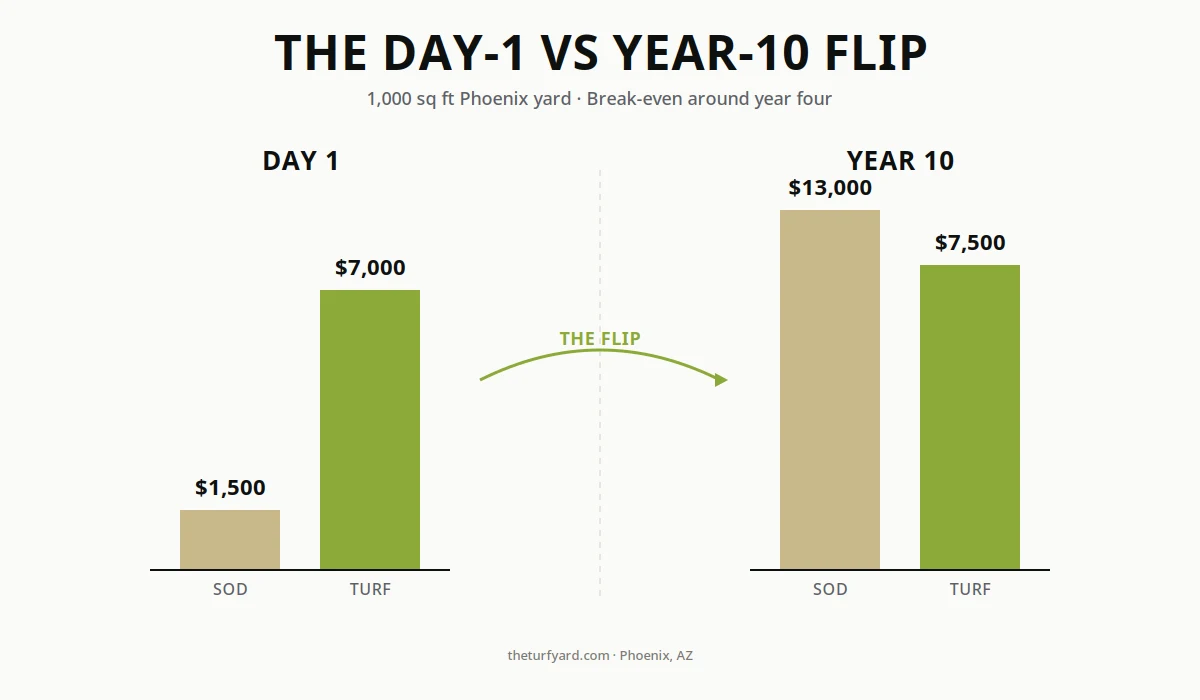
- Day one, sod is far cheaper (~$1,500 vs $6,000–$8,000 installed for 1,000 sq ft) — but the gap closes by year four, and by year ten sod has spent more.
- A 1,000 sq ft Phoenix lawn drinks about 50,000 gallons of water a year just to look normal; turf needs under 1,000.
- Heat is the honest knock on turf. A cooling infill plus a 60-second rinse manages it — don't buy dark turf with no infill and be surprised.
- Sod still wins for small shaded yards, committed lawn-care hobbyists, renters, and anyone who wants a living, pollinator-friendly yard.
Sod vs artificial turf at a glance
Before I get into the weeds (pun semi-intentional), here’s the boardroom version for a 1,000 sq ft Phoenix yard:
| Factor | Sod | Artificial Turf |
|---|---|---|
| Day-1 cost (1,000 sq ft) | ~$1,500 | $6,000–$8,000 installed |
| Lifespan | 5–10 yrs in AZ | 15–20+ yrs |
| Water (gal/sq ft/yr) | ~50 | <1 |
| Weekly maintenance | Mow, edge, water | Rinse, occasional broom |
| Year-round green | No — dormant Nov–Mar | Yes |
| Pet-safe | Yes, with cleanup | Yes, with the right infill |
| AZ summer performance | Browns without heavy water | Heat-mitigating infills available |
| Weeds, crabgrass, clovers | Constant battle | Effectively zero |
| Allergens | Pollen, fertilizer dust | None |
| Warranty | None | 8–15 years typical |
| Resale value in AZ | Mixed | Increasingly positive |
| HOA acceptance in AZ | Yes | Yes in most communities |
A general comparison for a 1,000 sq ft Phoenix yard. Your numbers shift with yard size, water rates, and how the space gets used.
That’s the surface read. The actual reality is messier, so let’s get into it.
What you’re actually choosing between
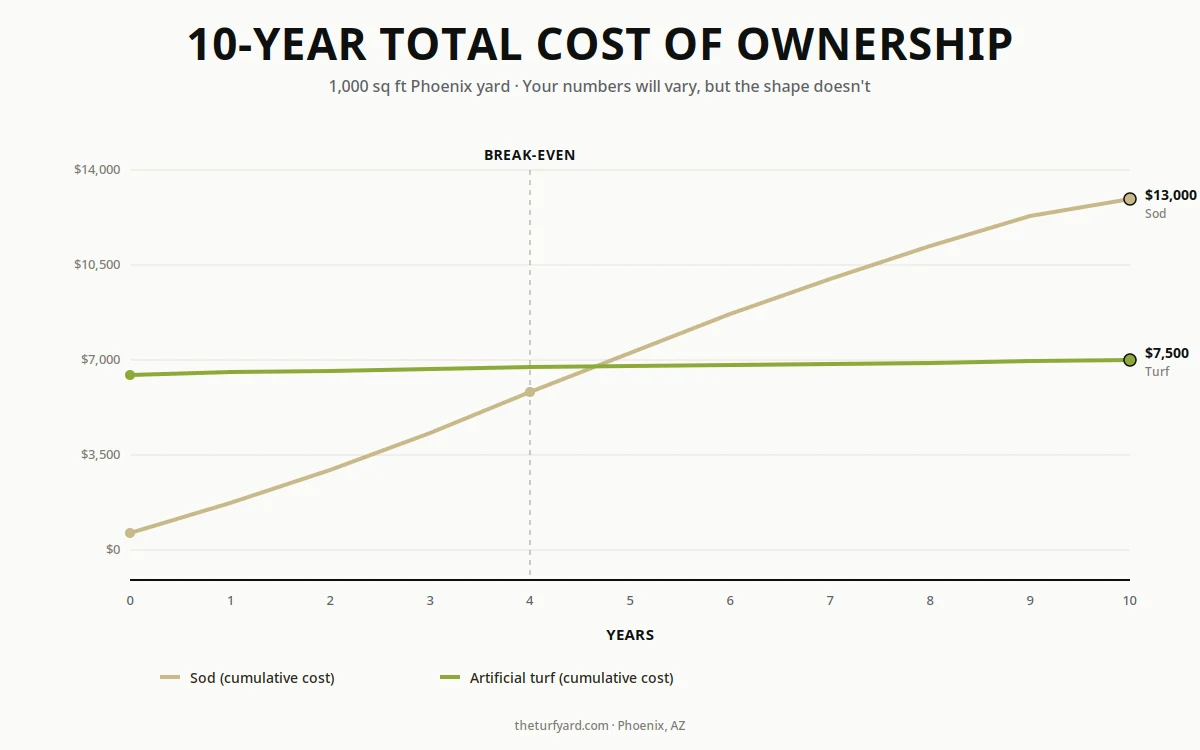
A thousand square feet of Phoenix yard is roughly a $1,500 sod install or a $6,000 to $8,000 artificial grass install. That gap looks huge on day one. By year four it’s gone. By year ten, sod has actually spent more.
It depends on a few real things, sure. But for most Phoenix homeowners, the artificial turf vs sod question isn’t actually that close. (If you want to model the comparison against natural grass more broadly, we go deeper in artificial turf vs natural grass.)
What it actually costs over 10 years
Cost is what most people are searching for, so I’m not going to bury it. The honest answer on artificial turf cost in Arizona is that the upfront number scares people off, and then the 10-year number quietly flips it.
Day one. Sod runs about a dollar to two dollars a square foot installed in the Valley. Installed synthetic turf typically lands in the $6 to $8 a square foot range, and where you fall mostly comes down to how much demo the yard needs — pulling out existing sod, capping irrigation, working around hardscape, or dealing with access issues. That installed price covers everything: materials, base prep, infill, fasteners, and labor. (Want a real number for your yard instead of a range? Run our cost calculator.)
Year one. Sod is where the bleed starts. A 1,000 sq ft Phoenix lawn drinks somewhere around 50,000 gallons of water a year just to look normal — the kind of season-by-season watering load the Arizona Municipal Water Users Association lays out for desert landscapes. At current Phoenix water rates, you’re looking at $1,000 to $1,500 a year on water alone. Add another $300 to $600 on fertilizer, pre-emergents, and soil amendments. Add $50 to $80 a month if you pay someone to mow. Artificial grass, for comparison, costs maybe $50 to $150 a year — mostly a rinse for pet areas and the occasional infill top-up.
Year three. A lot of Phoenix sod lawns need partial re-sodding by year three. Could be pet damage, could be a sprinkler head that went sideways while you were on vacation, could just be the summer that finally got to it. It’s not catastrophic, but it’s a real cost that nobody factors in when they’re looking at the day-one number.
Year seven to ten. Some sod lawns make it that long. A lot don’t. Most properly installed turf at year seven looks pretty close to how it looked at year one.
I actually tracked my own water bill the year after I switched. From June to June, it was down 38% compared to the prior year with sod. The turf didn’t save me a fortune in year one — but it saved me about $700, and that’s just the water line. (If water is your main motivation, that’s its own deep dive: artificial turf and water conservation.)
None of this is the actual reason I switched, by the way. But it was nice that the math ended up working out.
See your own 10-year numbers
Plug in your square footage and current water and lawn-care spend, and our calculator shows where the break-even point falls for your specific yard.
The Arizona problem nobody talks about
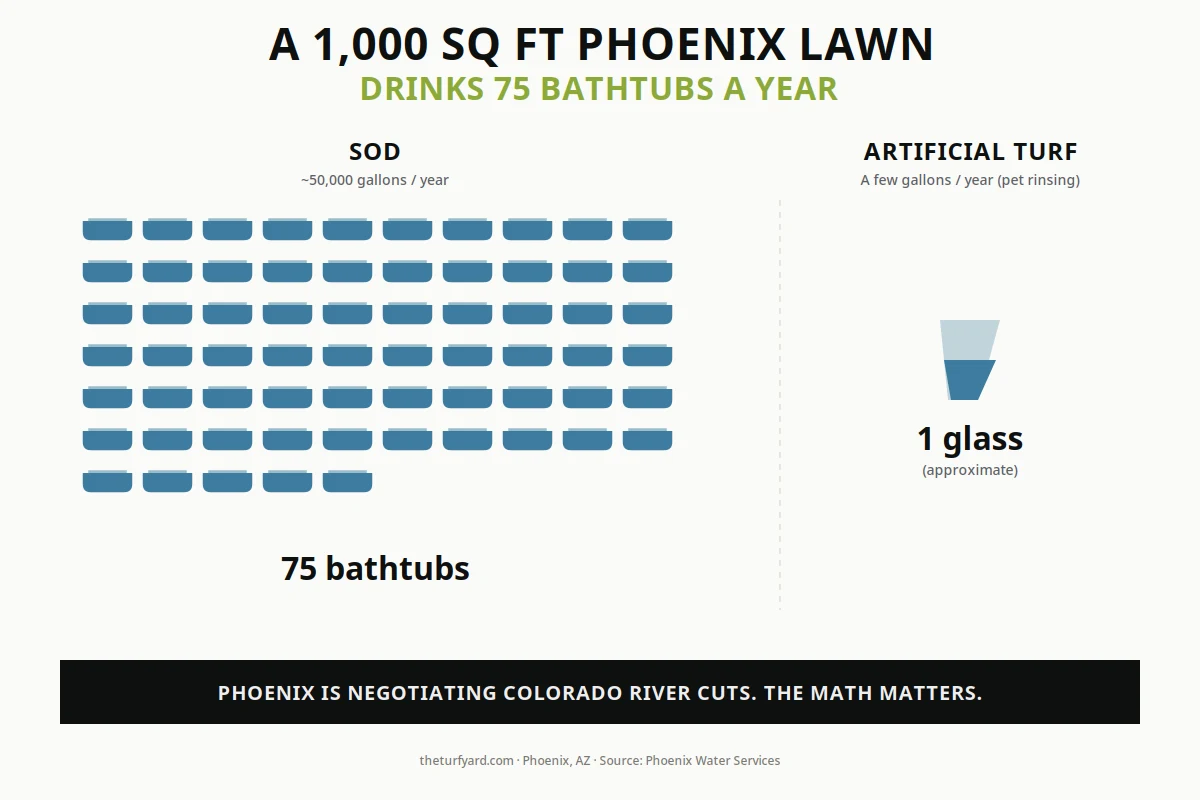
A 1,000 square foot Phoenix lawn uses about 50,000 gallons of water a year.
That’s not for a showpiece. That’s just to keep a normal lawn alive. And during a bad summer — monsoon delays, a real heat dome — even that isn’t always enough. Sod stresses, browns out, and re-sodding starts becoming an annual line item instead of a one-time install. It’s not a small backdrop, either: the Colorado River Basin is in long-term shortage planning, and the Arizona Department of Water Resources keeps tightening the conversation around outdoor water use.
Then there’s the soil. Most Valley yards sit on caliche, which is that cement-like calcium carbonate layer that real grass roots can’t punch through. Decent sod installs require breaking it up and amending it properly. Skip that and you’re going to be paying for sod again in three years.
The honest counter-argument against artificial grass is heat. And yes — dark-fiber turf can hit 140 to 170 degrees at two in the afternoon in July. So can your driveway. So can the dirt patch next to dead sod. So can your car hood. The way you actually manage this is the infill: cooling sand blends, a zeolite infill like our PetFill Pro, the BrockFill-style products. They drop surface temperature 20 to 30 degrees, and a 60-second rinse drops it another 30 on top of that. It’s a real consideration, but it’s not a dealbreaker if you spec the install correctly — which is the whole point of our deeper guide on whether artificial turf gets too hot. We see the same thing across Phoenix yards every summer.
My kids run barefoot — and in socks — on the turf at four in the afternoon in July. They ran on the sod too, but with a lot more complaints about how poky it was. There were always ants. The turf is just predictable. You know what you’re stepping on.
The real reason I switched
I want to come back to this because it’s actually the part that matters: I liked having grass. I liked the mowing. None of that was the problem.
The problem was that the lawn had become a low-grade ongoing project that I never got to finish. Every spring I’d be out back trying to figure out why that patch was brown, where the crabgrass came from again, why pre-emergent didn’t seem to work last fall, whether I’d watered too much or not enough. And honestly, some years I just didn’t have it in me. I’d grab a bag of seed, throw it down, and call it a summer.
What I didn’t expect when we put the turf in — what nobody really told me when I was researching this — wasn’t that the yard would look nicer. I knew it would look nicer. What I didn’t expect was this:
“The yard is inviting now. My family has picnics out there. That never happened when we had real grass.”
That’s the thing. That’s the whole sentence.
When we had real grass, the yard wasn’t a place we hung out. It was a chore. There were always clippings stuck to whatever you sat on. There were ants. There were bees in the clovers. There was fertilizer dust. There was mud after the sprinklers ran. And there was always the suspicion that the spot you’d just put a picnic blanket on was the brown spot you were going to be trying to fix on Saturday anyway.
Turf doesn’t have any of that. It’s just yard. The way a yard is actually supposed to feel when you walk out there. (That shift — from chore to usable space — is the same one we hear from nearly everyone in why Arizona homeowners are switching to turf.)
I still walk outside some Saturday mornings and miss the mower. Then I look at my kids sitting on a picnic blanket in 105-degree weather and I get over it pretty quickly.
Pets, kids, and the safety question
The honest answer is: it depends on the install, and it depends on the household.
On pets. Our dog loves laying out in the yard in the sun. It’s May as I’m writing this, already in the high 90s, and she’s out there anyway. That didn’t happen on sod — too poky, too patchy, too much going on at ground level.
Drainage matters way more than the fibers do, but it also depends on what kind of dogs you have. We have a small dog and went with the standard infill, no upgraded pet product. Over the last couple of years we’ve never treated it, never had it professionally cleaned. It still looks brand new and it still doesn’t smell. If you have a couple of large dogs the math changes — a pet-rated infill like our PetFill Pro zeolite infill (figure around $22 per 50 lb bag) plus an enzymatic spray a couple times a year ($25 to $40 a bottle) handle the volume. But honestly, if you have one small dog, don’t let an installer upsell you on a pet-specific package. You probably don’t need it. If you’re shopping specifically for dogs, we walk through it on the pet turf page.
On kids. Parents also ask what’s actually in the turf — lead, zinc, PFAS. Modern residential turf from reputable manufacturers tests well below action thresholds, and it’s nothing like the 2005 sports-field crumb rubber that most of the concerning studies were actually about — the kind the EPA and CDC studied under their Federal Research Action Plan. If an installer can’t hand you a current product spec sheet on request, that’s your answer.
My daughter does round-off back handsprings, backflips, and aerials on the turf in the backyard. It’s more forgiving than patchy grass over rock-hard Arizona dirt — which, let’s be honest, is what most “natural lawns” in the Valley actually are by August. If a kid in your house has had a reaction to a school turf field, that’s real, and you should ask about the specific product and infill before installing. That’s an honest concession, not a sales objection.
When sod is still the right call
Sod isn’t always the wrong answer. Here are the actual situations where I’d tell someone to stick with it.
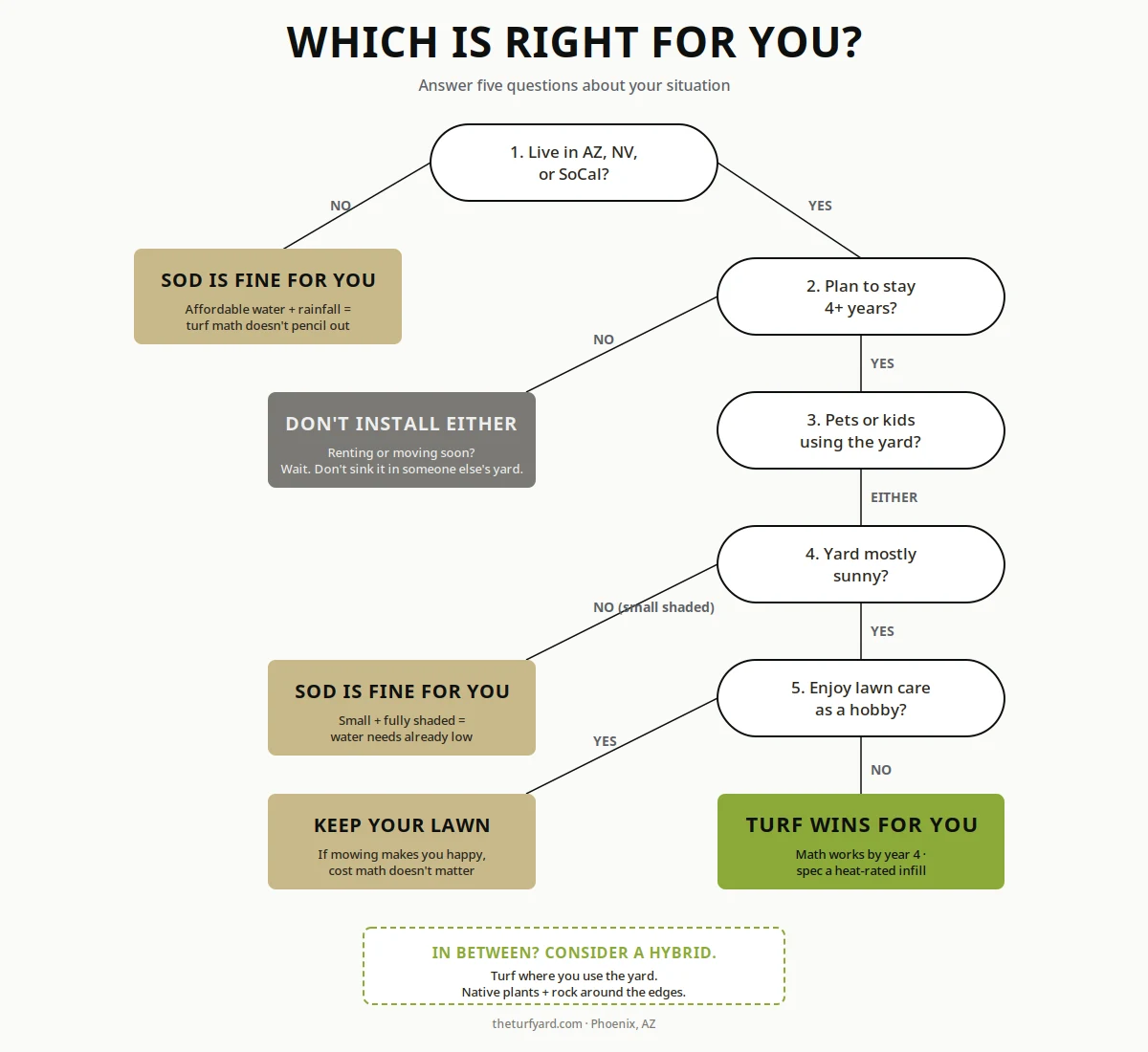
If your yard is small and fully shaded, the turf math doesn’t pencil out as quickly because the water needs are already low. Stay with sod. If you genuinely enjoy lawn care as a hobby — and some people honestly do, the same way some people love smoking meat or working on cars on Saturdays — keep your lawn. The cost math doesn’t really matter when something’s doing real work for your weekends.
If you’re renting, or your living situation might change in the next year, don’t install either one. You’d be spending money on someone else’s yard. If you live somewhere with affordable water and reliable rainfall — most of the country, not really Arizona — sod is fine. And if you want pollinators and a “living” yard, that matters, and you should listen to it. Synthetic surfaces don’t support bees. The honest hybrid answer for AZ is a smaller install where you actually use the yard, with native plants and rock around the edges.
That’s not a small list. Sod isn’t dead, and there are real homes where it’s the right answer. It’s just that most Phoenix yards — with kids, pets, and a normal water bill — aren’t usually one of them.
What installation actually looks like
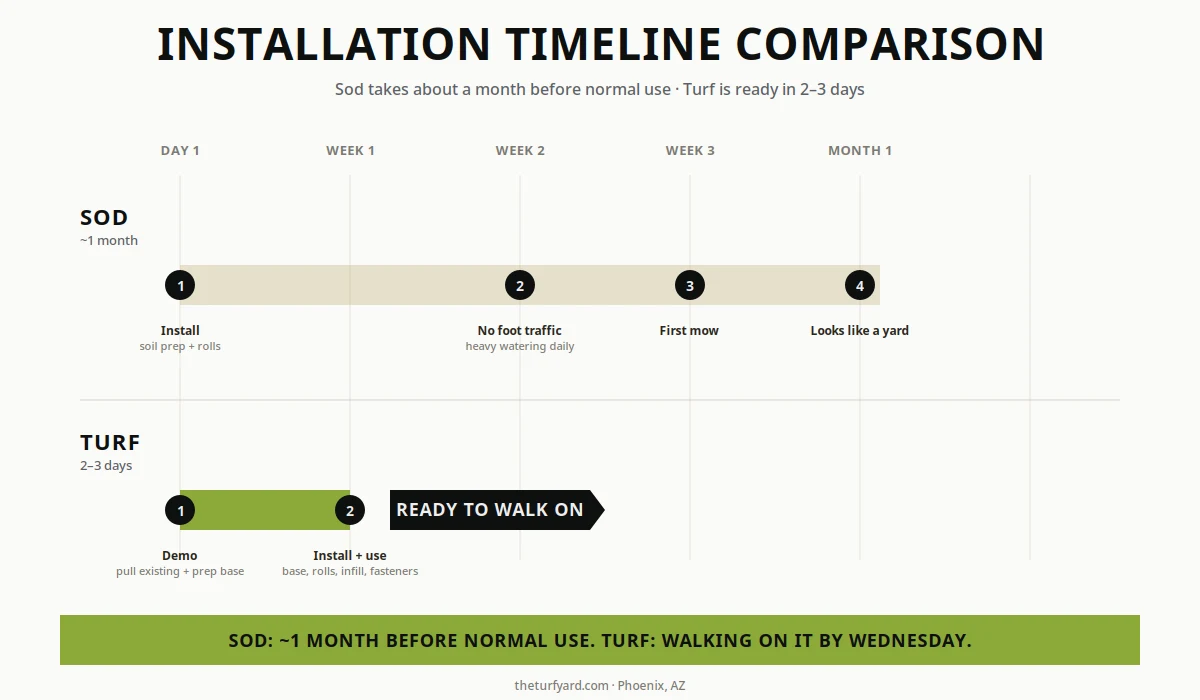
The sod install timeline goes something like this: day one is soil prep and amendments (which in AZ means actually breaking up caliche, which is real work). Days one to two, the rolls go down. For the next week or two, you’re watering heavily every day and keeping foot traffic off. Around week three you can do your first mow. Realistically, it’s about two weeks before it starts to look like your yard.
The synthetic turf install timeline is shorter and simpler. Day one is demo — pulling the existing lawn and prepping the base. Day two, the base gets compacted, the rolls go down and get seamed, infill gets brushed in, and fasteners go down. By Tuesday evening or Wednesday morning, you’re walking on it. Permanently.
On cost: sod DIY runs about $0.50 to $0.75 a square foot if you handle the prep yourself, and $1.50 to $2.50 installed. Turf DIY is technically possible — we even have a full DIY turf install guide — but I wouldn’t recommend it for most homeowners. Base prep is where most failed turf installs go wrong, and re-doing it isn’t a small repair. If you’d rather have a crew handle it, that’s what our artificial turf installation service is for, and we run jobs out of our Mesa yard across the Valley. Installed turf typically lands in the $6 to $8 a square foot all-in range, depending on demo scope — a clean dirt yard near the low end, a yard that needs sod removed, irrigation capped, and tricky hardscape worked around near the high end.
The trade-offs nobody talks about
Resale. In Arizona, artificial grass is increasingly seen as a feature rather than a deduction. We’ve heard the same story from realtors across Mesa, Chandler, Gilbert, and Scottsdale: a low-maintenance, water-smart yard reads as a positive to buyers. There are exceptions. A synthetic lawn in a 1920s historic district might not help. In most of the Valley’s master-planned and post-2000 communities, it does.
Environment, honestly. It’s plastic, and at end-of-life it’s landfill or specialty recycling. That’s the real downside and I’m not going to pretend otherwise. Microplastic shedding from residential installs is a real concern but pretty minor compared to sports-field use. Heat island effects matter when it’s right up against asphalt, less so in a fenced residential yard.
The honest counter is the water savings: 50,000 gallons per 1,000 square feet per year, in a state that’s living with real Colorado River cuts. If the environmental math still tips you toward sod, I respect that — and there’s actually a third option worth mentioning, which is a synthetic turf-plus-native-plant hybrid. You put it only where you’d actually use it (around the patio, where the kids play), and let the rest be native plants and rock. That’s often the most AZ-honest answer.
Allergies. This was one of mine. My spring allergies didn’t disappear when we made the switch, but they noticeably improved that first spring without grass. No fresh-cut grass particles in the air. No fertilizer dust during the application weeks. No mowing day.
Want a Side-by-Side on Your Own Yard?
We do free quotes for both sod and turf, free samples to your door, and an honest on-site walkthrough — even when the honest answer is to keep the grass.
- 4.9 from 300+ reviews
- 12-year manufacturer warranty
- Arizona & Utah
What Customers Say
5.0 from 480+ verified Google reviews
AWESOME EXPERIENCE. I was working with a different supplier who fell through and I’m on a bit of a time crunch on my project. I hit up The Turf Yard and they gave me a very reasonable price for the turf and were able to deliver it the same day. I was extremely impressed. I would 200% recommend and will be coming back for more business when I’m ready to finish my project in it’s entirety. Thanks y’all!
So friendly and helpful! Came in with a specific need for my unfinished backyard and they had exactly what I needed. They were quick and even helped ratchet strap the grass roll onto the roof of my car (but delivery is an option!). The artificial grass is high quality and I’ll add a photo once I have it installed! 5/5 ⭐️ highly recommend and will utilize again for future projects!
Expert Tips
— Daniel Skillman, Phoenix homeowner
Run Your Own 10-Year Number
Don't decide on the day-one price. Add up sod's water, fertilizer, mowing, and re-sodding over ten years before you compare. That's where the real answer lives.
Spec the Infill for Heat
In the Valley, a cooling infill is not the upsell to skip. It's the difference between barefoot-in-July and 'why is this so hot.'
Don't Over-Buy Pet Products
One small dog on a well-drained base usually doesn't need the premium pet package. Two big dogs is a different story.
The Base Is the Whole Game
Most failed turf installs are base failures. If you DIY anything in the yard, DIY the sod and let a crew handle the turf base.
Consider the Hybrid
You don't have to turf the whole yard. Put it where you actually use the space and let native plants and rock handle the rest.
— Daniel Skillman, Phoenix homeowner
Related Services
My honest recommendation
If you’re in the Valley, have kids or pets, water with city water, and plan to stay four or more years in your home — go with artificial grass, and spec a quality infill rated for AZ heat. The math works by year four, and the lifestyle change is bigger than what shows up in the spreadsheet. The residential turf page walks through what a good install actually includes.
If you have a small shaded yard and you actually love lawn care, stay with sod. Don’t let anyone — including me — talk you out of something that brings you joy on a Saturday morning.
If you’re in between — single-person household, medium yard, no pets, mixed sun — look at a hybrid. A small install in the area you’d actually use, where the picnic blanket goes. Sod or xeriscape for the rest.
If you take nothing else from this article: don’t believe anyone who tells you it’s a tie. Run your own numbers. Look at your actual yard. Pick the one your family is going to use.
For me, that meant picnics. For you, it might mean something completely different.
The Turf Yard is a Valley-based turf supplier with installation crews across Mesa, Phoenix, Scottsdale, Gilbert, Chandler, Tempe, and most of the Valley — and a second yard in Provo for our Utah customers. We do free side-by-side quotes (sod and turf, both, no pressure), free samples mailed to your door, and honest on-site walkthroughs where we tell you what we’d actually do for your specific yard. Contractors and installers can get wholesale turf pricing too. If turf isn’t the right answer for you, we’ll tell you — we’d rather pass on a bad install than win a customer who’s going to regret it. Get a free quote or order free samples at contact us, or call (480) 910-2440 (Mesa) or (385) 335-9042 (Provo). There’s no perfect lawn in Phoenix — there’s only the one your family is going to actually use.