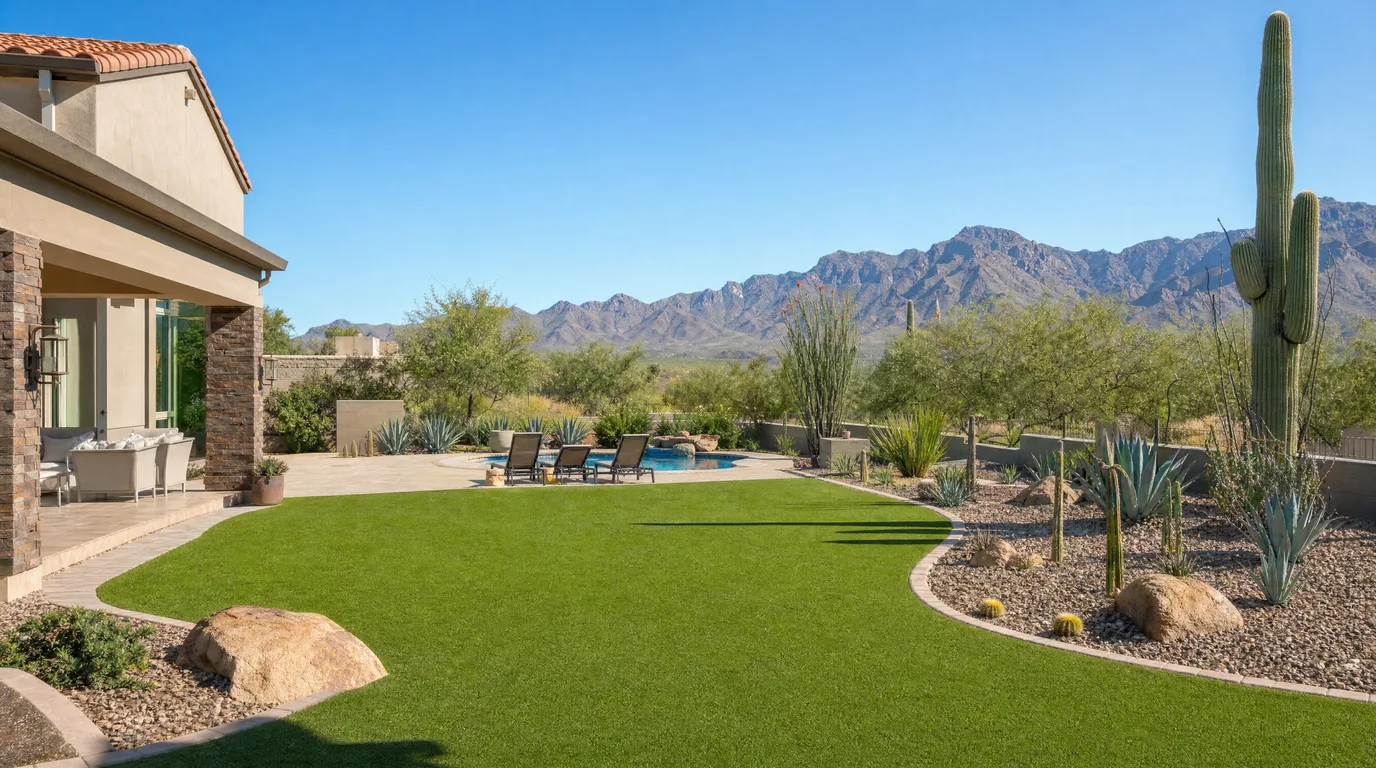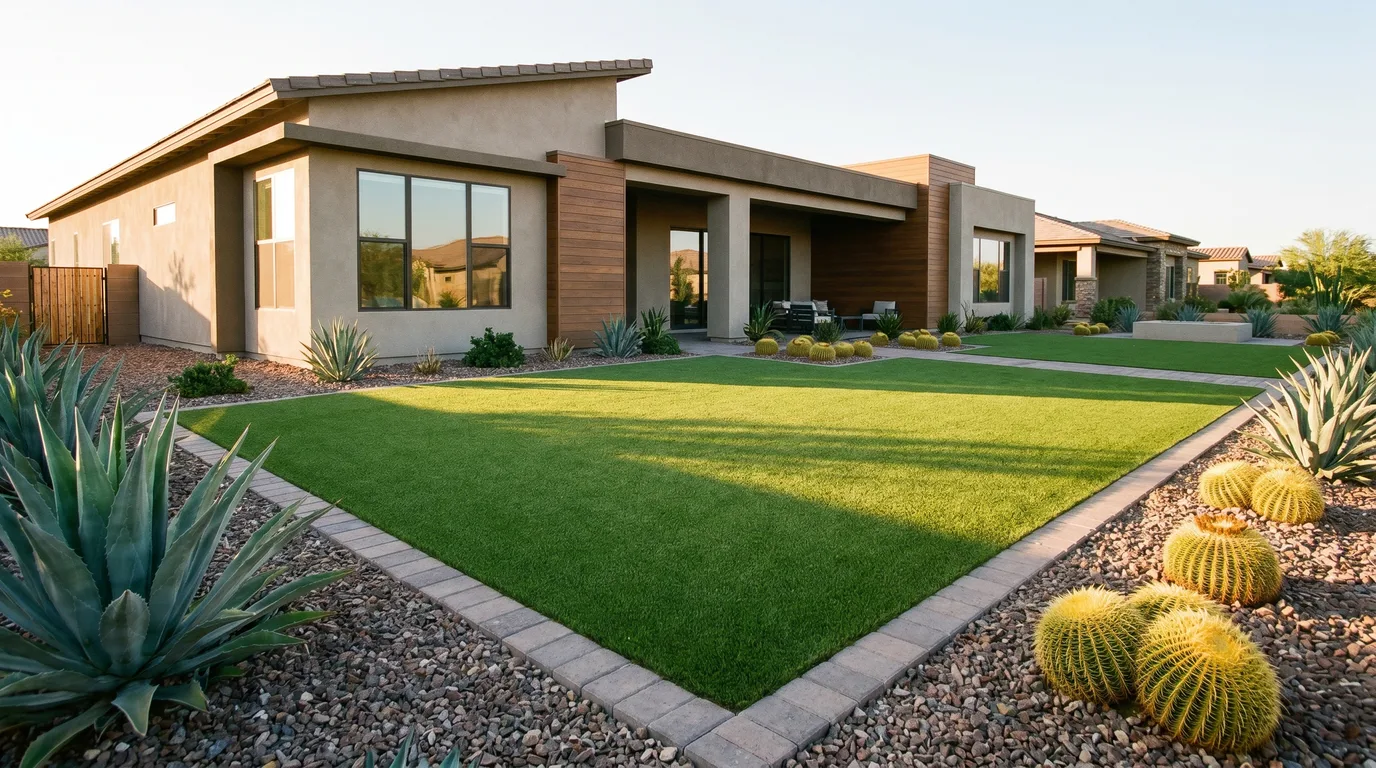
My old lawn drank more water than the rest of the street combined and still looked like a parking lot by July. The water bill was the part that finally got me — it climbed every summer like it was training for something. So I did what a reasonable person does. I stopped watering a thing that kept dying on me anyway.
That’s the whole pitch for artificial turf water conservation, and the rest is detail. If you want to save water with turf, you’re not trimming usage or being clever with a smart timer — you’re deleting the single biggest water user on the property. Turf needs no irrigation. The lawn stops being a line on your summer bill, it stops caring about watering restrictions, and it stays green while the neighbor’s grass goes the color of a paper bag. It’s low-water landscaping, not a magic eco-cure. But as a way to quit irrigating, nothing else comes close. If you’re weighing turf against keeping a real lawn, the fuller money-and-water math is in artificial turf vs natural grass and sod vs artificial turf.
TL;DR — Quick Answer
Artificial turf needs zero irrigation, so the biggest water user on most properties — the lawn — just disappears from your summer bill. The only water it ever wants is an occasional rinse for dust or pets. It stays green through droughts and watering bans because there's nothing to keep alive, and both Arizona and Utah run grass-removal rebates that help cover the switch.
Irrigation it needs
Zero gallons
Biggest payoff
The summer water bill
Phoenix rebate
$2 per square foot
Most common myth
That it's 100% green
Thinking About Ditching the Lawn?
Get straight answers on turf, rebates, and what your square footage actually costs — no pressure, no obligation.
Table of Contents
Key Takeaways
- Turf needs zero irrigation, so the lawn — usually the biggest water user on a property — drops off your summer bill entirely.
- Landscape irrigation can run 50–70% of residential water use in the desert summer; turf takes that load to nothing on the area it covers.
- A real Southwest lawn can drink 50,000+ gallons a year on a modest yard; turf drinks an occasional rinse.
- Both states help pay for the switch — Phoenix pays $2 a square foot to pull live grass, and several Utah districts run their own grass-removal incentives.
- It's low-water landscaping, not a 100%-green miracle — be honest about the install footprint and the heat, and it's still the most direct way to stop irrigating.
What a Real Lawn Costs You in Water
Start with the part you actually feel: the bill. A natural lawn in the desert is the thirstiest thing you own, and it never lets you forget it.
Lawns here get almost no help from the sky. Phoenix averages fewer than 8 inches of rain a year. Salt Lake City gets a bit more, but the summer heat and dry air evaporate most of it before grass roots can use a drop. So the lawn lives on your sprinklers, and your sprinklers run long and run often. The Arizona Department of Water Resources puts it plainly — the average Arizonan uses about 146 gallons of water a day, and up to 70 percent of that goes outdoors, mostly onto landscaping.
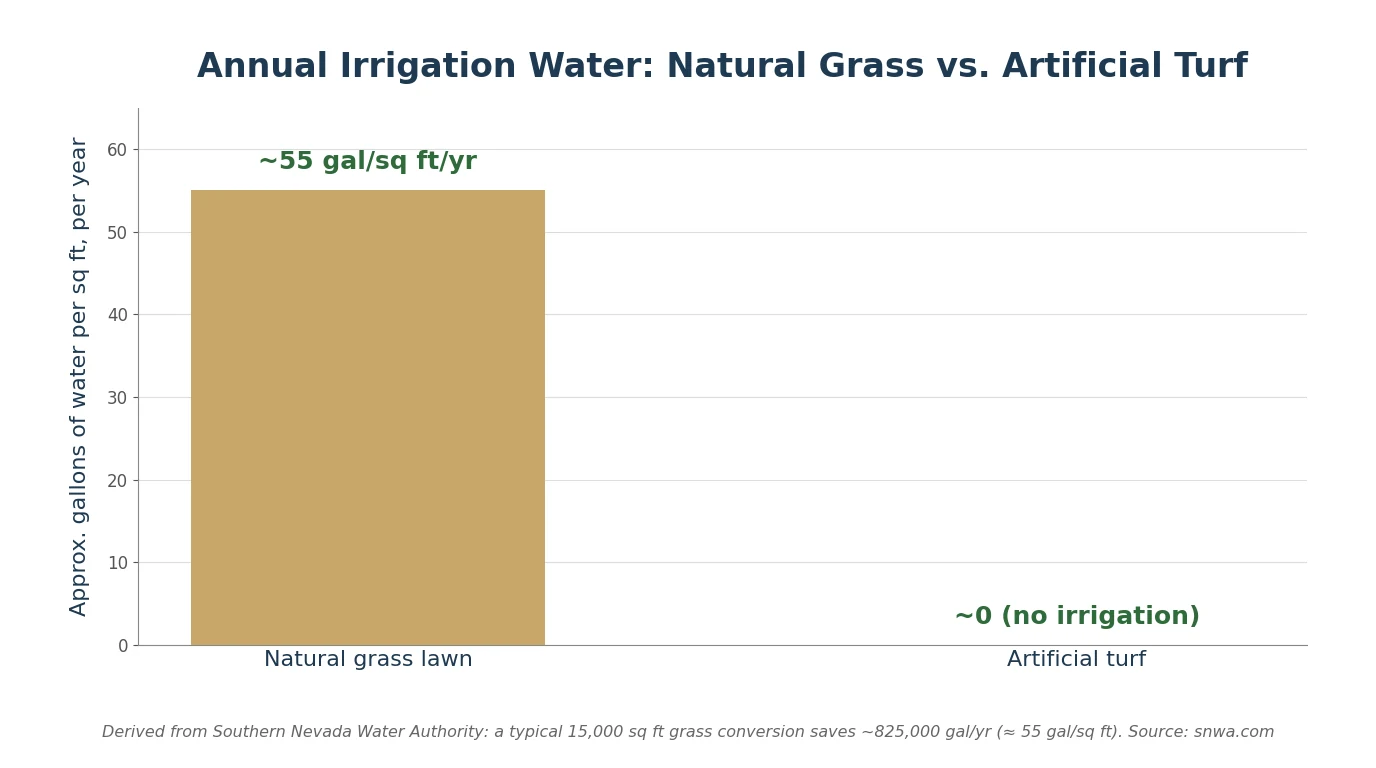
The numbers behind that are stark. The Southern Nevada Water Authority — which manages water for the Las Vegas metro and has studied Southwest lawn irrigation for decades — estimates a typical 15,000-square-foot grass conversion saves about 825,000 gallons a year, or roughly 55 gallons per square foot. Run that on a 1,000-square-foot front yard and you’re looking at about 55,000 gallons a year. A 2,500-square-foot backyard pushes well past 130,000 gallons — all of it going purely into keeping grass alive long enough to mow it again.
Zoom out and it’s worse. The EPA’s WaterSense program puts American residential outdoor water use at nearly 8 billion gallons a day, most of it landscape irrigation. In a climate like ours that share skews higher. Artificial turf uses essentially none of it. Once it’s down, irrigation is done.
What Removing the Lawn Does to Your Bill
Here’s the part the white papers skip. You don’t conserve your way to a smaller lawn bill — you remove the lawn and the bill for it goes with it.
In the desert summer, landscape irrigation is often the single largest discretionary thing on your water statement. It’s the part you could turn off if the grass weren’t going to die. Turf turns it off and nothing dies. The irrigation load on the area you cover drops to zero and stays there for the 15-to-20-year life of the install. You still rinse it now and then — we’ll get to that — but a rinse next to a summer of sprinklers is a rounding error.
I won’t print a savings percentage, because your bill depends on your yard, your provider, and your old watering habits, and anyone quoting you an exact figure is guessing. What I’ll say is this: every customer who switched did it for one reason, and it wasn’t the polar bears. It was the line on the bill that grew every July. Turf is the one move that makes that line stop growing — permanently.
The Drought Context, Kept Short
You’ve heard the Colorado River talk for years now, so I’ll keep this tied to your yard instead of the basin.
Arizona is under an active Tier 1 shortage on the Colorado River — a 512,000 acre-foot cut to the state’s annual supply, about 18% of its river apportionment. The Central Arizona Project delivers that river water to Phoenix, Mesa, Chandler, Gilbert, and dozens of other Valley communities, and the rules governing how it all gets divided expire at the end of 2026. In Utah it’s a different shape but not a kinder one — southern Utah draws from the same Colorado River, and the Great Salt Lake’s drop keeps conservation on every district’s mind.
What that means for you is simpler than the headlines. Cities are leaning hard on outdoor-water conservation because landscape irrigation is the biggest discretionary use a household can cut. That’s exactly why the rebate money exists. Your lawn and the basin are connected by the same hose.
Rebates in Arizona: Money Back for Pulling Grass
Several Valley cities will pay you to convert living grass. Programs change and funding runs dry, so treat this as a starting point and confirm with your provider before you touch a sprinkler head.
City of Phoenix. The Residential Grass Removal Program pays $2 per square foot to remove live grass and replace it with a water-smart surface, which may include artificial turf. Per the City of Phoenix Water Services page: there’s a 250-square-foot minimum, the grass has to be alive and at least 75% dense when you apply, and you need pre-approval — a Notice to Proceed — before you remove anything. Bare dirt doesn’t qualify; you have to install a real replacement. On a 1,000-square-foot front yard, that’s $2,000 back. Not nothing.
City of Mesa. Mesa runs its own grass-to-xeriscape program through its water conservation office. In 2024 alone it drove roughly 330,000 square feet of turf removal across homes, HOAs, and businesses. Check Mesa Water Services for current residential terms.
Other Valley cities. Chandler, Tempe, and Scottsdale have run their own turf-removal incentives. Chandler’s large-landscape program, for instance, covers 25% of project costs up to $20,000 for commercial and large-landscape conversions. Check your local provider — amounts and funding vary a lot, and they move.
If you want a sense of how big these programs get, the Southern Nevada Water Authority pays $5 a square foot just across the line, one of the most aggressive rebate rates in the country. Las Vegas isn’t paying that for fun.
Rebates and Restrictions in Utah
Utah is a quieter version of the same story, and the restrictions matter as much as the rebates.
Programs vary by district and season. Communities along the Wasatch Front and in the St. George area have run grass-removal and xeriscape incentives through providers like Weber Basin, Jordan Valley, and the Washington County Water Conservancy District. They come and go, so check your district directly. The state’s own Division of Water Resources runs the long-standing Slow the Flow campaign and tracks where the savings have to come from — and the answer, same as Arizona, is outdoors.
The part that sells Utah homeowners is what happens during a watering restriction. Stage 1 and Stage 2 limits tell you which days and hours you can run sprinklers, which is a slow death sentence for a real lawn in July. Turf doesn’t read the calendar. There’s nothing to keep alive, so it’s green on watering days and non-watering days alike. A short irrigation season doesn’t change the math — it just means the lawn is stressing the most water-stressed months of the year.
Do You Actually Have to Water Turf?
No. This one comes up at the counter constantly, so let me be flat about it: artificial turf needs no irrigation water.
Your turf looks the same in an August drought as it does in February after a storm. The fibers don’t need water to stand up, stay green, or survive. There’s no root system to keep going. Nothing dries out, because nothing was ever alive.
The only time water touches turf is cleaning, and it’s optional:
- Occasional rinse. In pet areas especially, a hose-down once a week or two in summer flushes debris and keeps odor in check. That’s maintenance, not irrigation.
- Cooling rinse. Turf soaks up sun like a patio and gets warm on a hot afternoon. A quick spray drops the surface temp in minutes before the kids or the dog head out. Totally optional.
- After a haboob. The Valley gets real dust events in monsoon season. A rinse clears the fibers, and it drains straight through the backing — no standing water.
That’s the entire water budget. We supply turf across the Arizona service area and tell every customer the same thing: budget zero gallons for irrigation, and a little for the hose if you’ve got a dog.
The Honest Trade-Offs
I’d be a lousy neighbor if I sold you turf as flawless, so here’s the straight version.
It gets warm in direct summer sun. Turf absorbs solar heat the same way a concrete patio or a parked car does. A rinse, a shade structure, or a lighter-colored product all help, but on a 110-degree afternoon it’s warm to bare feet. Anyone telling you it stays cool in full Phoenix sun has never stood on it in July.
It has an install footprint. Turf is a manufactured product. There’s base aggregate to haul, material to deliver, and a backing made of polyethylene — not a hedge. Calling it “100% eco-friendly” is a stretch nobody at this yard will make. What we’ll say is that it’s low-water landscaping that wipes out a huge, recurring chunk of outdoor water demand for 15 to 20 years, and that’s a real and lasting win even with the footprint counted honestly.
And it’s low-water, not no-care. You’ll rinse it, brush the high-traffic lanes, and top off the infill about once a year. That’s the trade for never mowing, watering, fertilizing, or overseeding with winter rye again. Most people take that deal in about four seconds. (My neighbor took longer, but my neighbor argues with parking meters.)
Lawn vs. Turf, Side by Side
Here’s the comparison without the marketing gloss.
| Natural Grass Lawn | Artificial Turf | |
|---|---|---|
| Irrigation water | Tens of thousands of gallons a year in the desert | Zero — an occasional rinse is the only water it wants |
| Summer water bill | Climbs every July; the biggest discretionary line | Lawn drops off the bill entirely |
| During a watering ban | Stresses and browns when you can't run sprinklers | Stays green — nothing to keep alive |
| Ongoing upkeep | Mowing, fertilizing, overseeding, watering | Rinse, brush traffic lanes, yearly infill top-off |
| Rebate eligible | It's what you're removing | Often the qualifying replacement surface ($2/sq ft in Phoenix) |
| Stays warm in full sun | Cooler underfoot | Warms up like a patio; a rinse cools it fast |
The honest split — turf wins decisively on water and the bill; a real lawn wins on summer surface temperature.
Myths Worth Killing
A few things get repeated about turf and water that deserve a quiet correction.
Thinking Turf Is 100% Green
It's low-water landscaping with a real upside — not a zero-impact eco-cure. It's a manufactured product with an install footprint. The water savings are real; the 'totally eco-friendly' label isn't.
Ignoring the Install Footprint
Base aggregate, delivery, and a polyethylene backing all count. Be honest about them, weigh them against 15–20 years of zero irrigation, and the trade still makes sense.
Assuming It Needs Watering
It doesn't. No roots, no irrigation, no exceptions. The occasional rinse is for dust and dogs, not survival.
Expecting It to Stay Cool
Turf warms in full sun like any hard surface. A rinse, shade, or a lighter product helps — but it's not chilled grass.
Get those four straight and you’re making the call with clear eyes, which is the only way we like selling anything.
Ready to Take the Lawn Off Your Water Bill?
We'll help you size it, price it, and sort out which rebate fits — for homeowners and contractors across Arizona and Utah.
- 4.9 from 300+ reviews
- 12-year manufacturer warranty
- Free quote & free sample
- Arizona & Utah
What Customers Say
5.0 from 480+ verified Google reviews
The Turf Yard guys were great to deal with. Special thanks to Haley and Clark for being friendly and punctual. Haley was able to answer all of my questions. We purchased a Lush 70 for our super budget front yard landscaping project. We were happy with the quality of the turf and the price. The transformation from dirt to turf makes a big difference. Look forward to working with them again on our next project.
I found the turf yard on Marketplace and emailed them on Sunday. I explained what I was looking for and was given several options to choose from. I only needed two 10X12 ft pieces and I chose which turf worked and had it delivered on Monday. The delivery charge was very reasonable as well as the turf cost. The kindness and service was exceptional! I highly recommend the turf yard! Marybeth Clark
Expert Tips
— Bennett Brown, Co-Founder
Get Pre-Approval Before You Pull Grass
Most rebate programs, Phoenix included, require a Notice to Proceed before you remove a single blade. Rip the lawn out first and you've usually forfeited the money. Apply, wait for the go-ahead, then dig.
Photograph the Old Lawn
Rebate applications want before photos and measurements. Snap the living lawn from a few angles before anything happens — it's the easiest paperwork you'll ever do and it protects the payout.
Budget Zero Gallons for Irrigation
When you re-plan your watering, the turf area is just off the system. Cap the line, skip the zone. The only hose it needs is for the occasional rinse.
Rinse, Don't Re-Water
If turf looks dusty after a monsoon, that's a two-minute rinse, not a watering schedule. It drains straight through the backing with no standing water.
Don't Oversell It as Eco-Perfect
If you're pitching an HOA or a spouse, lead with the water and bill savings, which are real and provable. Skip the '100% green' claim — it invites an argument you don't need to have.
Mind the Summer Surface Temp
For pets and bare feet, a quick rinse or a shade sail makes a full-sun yard comfortable. Plan a little shade into the layout and you'll never think about it again.
— Bennett Brown, Co-Founder
Related Services
The lawn was the thirstiest thing you owned, and turf is how you fire it. We supply the turf, the base, and the straight answers from our Mesa yard across the Arizona service area and from Provo across Utah. Swing by for a free sample, ask us anything about rebates, and we’ll size it up — call Mesa at (480) 910-2440 or Provo at (385) 335-9042. We’ll help you pick it, price it, and load it. Do it before your water bill needs its own zip code.