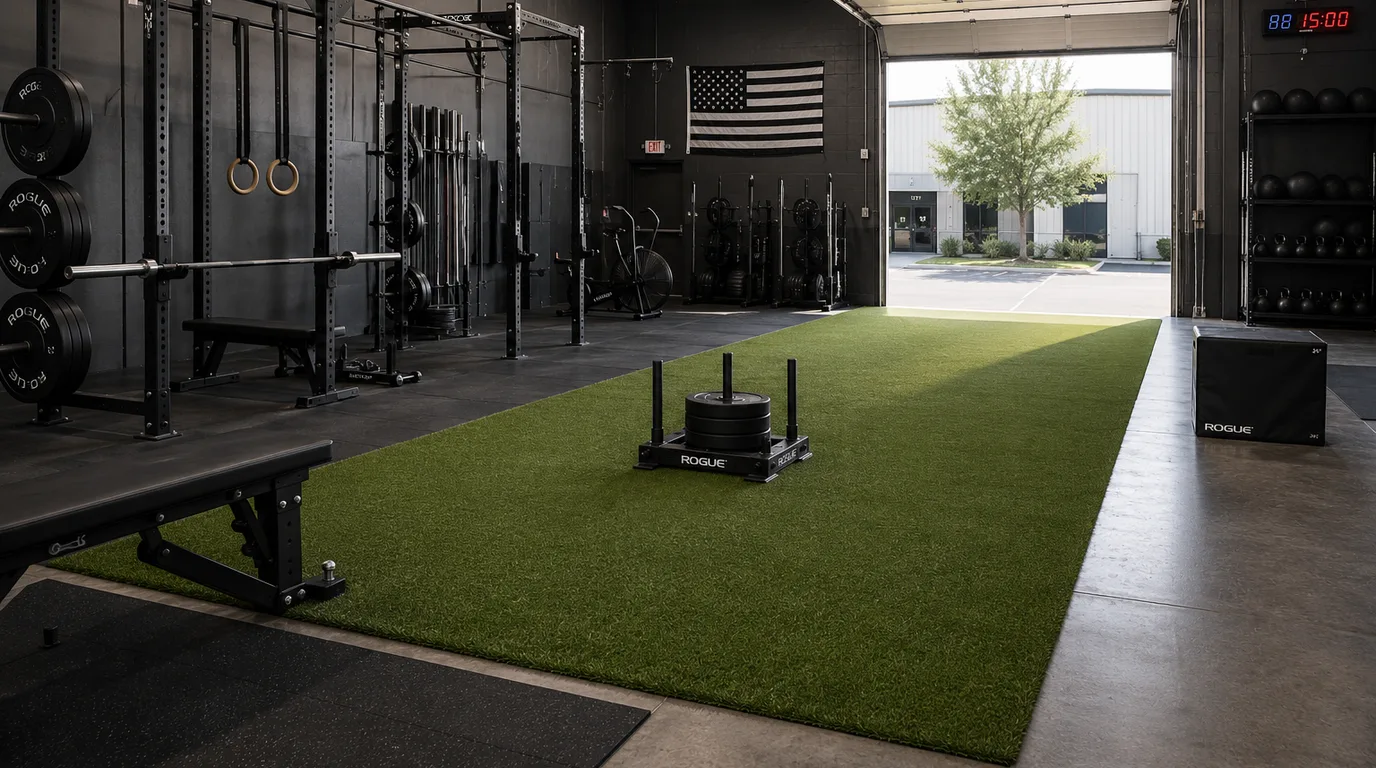
Your garage gym deserves better than the bare-concrete, gym-sock aesthetic it’s currently rocking. Indoor turf is how a lot of people fix that — a clean, forgiving, grass-like floor for lifting, putting, letting the kids tumble, or giving the dog a spot to do its business without a 2 a.m. trip outside. It’s the same idea as an outdoor lawn with one big change: what goes underneath.
That’s the whole trick, and it’s good news. Outdoor turf needs excavation, a rock base, and drainage. Indoor turf lays over a floor you already have — concrete, plywood, OSB — so the hardest part of a normal install just disappears. No digging, no plate compactor, no caliche trying to ruin your weekend. (We’re gonna need a bigger garage, maybe. A plate compactor, no.)
TL;DR — Quick Answer
Indoor turf lays over a hard floor — concrete, plywood, or OSB — not a soil base, so there's no excavation, aggregate, or drainage. Pick a short, dense, durable turf, add a shock pad wherever weights or kids land, and skip or lightly sand the infill. It's a great fit for putting greens, garages, and light play and gym areas; a hardcore weight room wants a padded, gym-specific turf.
Goes over
Concrete, plywood, OSB
Base needed
None — no soil or rock
Pick a pile that's
Short, dense, durable
Add a pad where
Weights or kids land
Price Your Indoor Turf Space
Enter your square footage and the calculator outputs a real materials number — turf, infill, and seam supplies — in seconds, no email.
Table of Contents
Key Takeaways
- Indoor turf lays over a hard subfloor — concrete, plywood, or OSB — so there's no excavation, no aggregate base, and no drainage to plan.
- Pick a short, dense, durable turf; a tall, plush landscape roll mats down under equipment and looks tired fast.
- Add a foam or rubber shock pad wherever weights drop or kids land — it protects the floor, softens falls, and quiets the room.
- Infill is optional indoors: non-infill for gyms and play, silica sand for an indoor putting green's roll.
- Loose-lay, double-side-tape, or glue with a low-VOC adhesive — and check a basement slab for moisture before anything goes down.
Indoor Turf vs Outdoor Turf: What Changes
Same blades, completely different job underneath. Outdoors, the turf is a system riding on a built foundation — a compacted rock base, drainage, and infill weighing it down. Indoors, the floor is already the foundation, so three things change.
No base, no drainage. Your concrete slab or subfloor is flat and stable already. There’s nothing to excavate and nowhere for water to go, because there isn’t any — spills get wiped, not drained. That’s why the hardest, sweatiest part of an outdoor install simply doesn’t exist indoors.
Padding replaces the base. Outdoors, the rock cushions and supports. Indoors, that job goes to a foam or rubber shock pad where you need impact — under a weight area, a sled track, or a kids’ zone. On a cardio corner or a decorative strip, you may not need any.
Pile and infill shift. A short, dense pile takes equipment and traffic without crushing. Infill, which outdoors is non-negotiable, becomes optional: gyms and play areas often run non-infill for a clean surface, while an indoor putting green still wants silica sand brushed in to true up the roll.
Where Indoor Turf Goes
Most indoor turf lands in one of five spots, and the right setup is a little different for each.
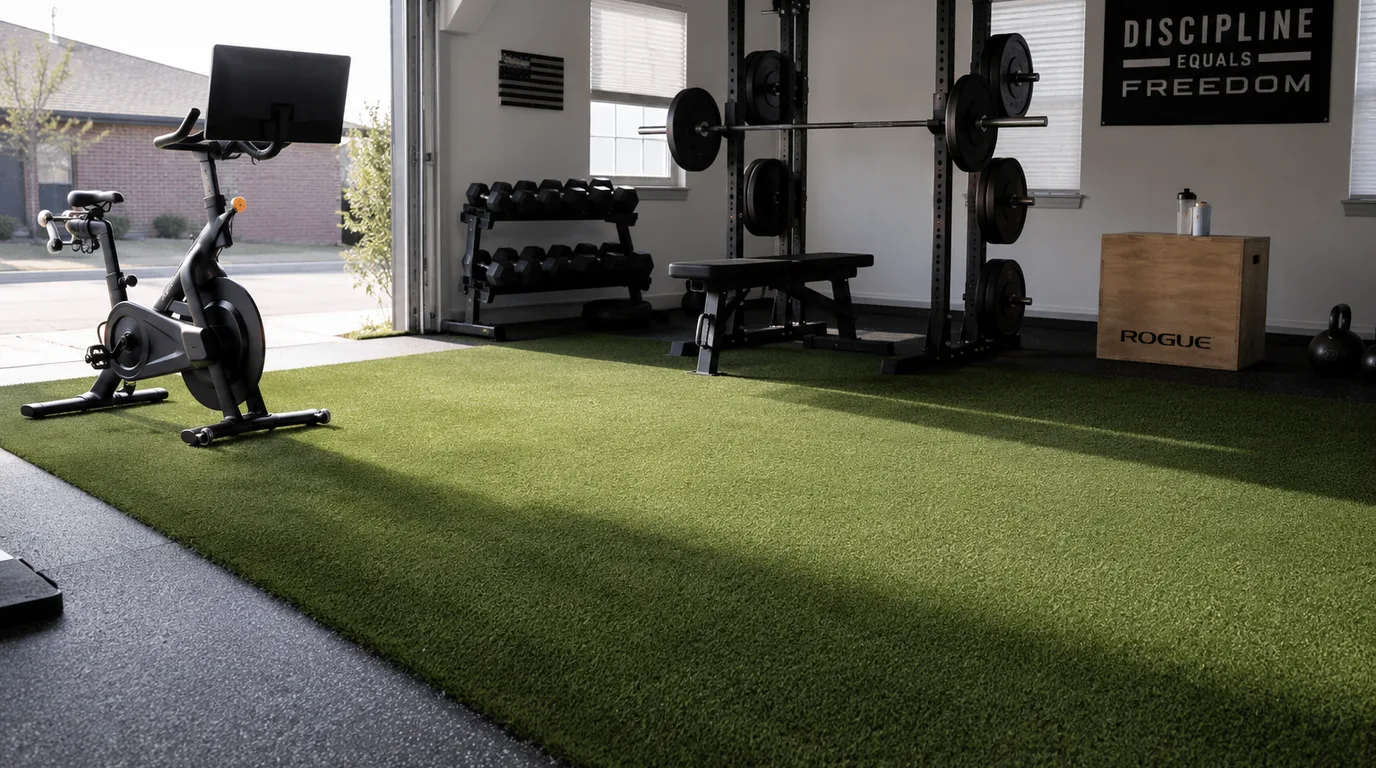
Home gym and garage. The big one. Turf over a slab gives you a forgiving surface for lifting, stretching, and conditioning, plus a sled lane that doesn’t chew up the floor. Drop weights or push a sled and you want a shock pad under the turf — it saves the slab and gives your downstairs neighbor one fewer reason to file a complaint.
Basement. Great for a playroom or a putting room, with one caveat: check the slab for moisture first. A damp basement floor needs a moisture barrier before turf, or you’re growing a science project under there.
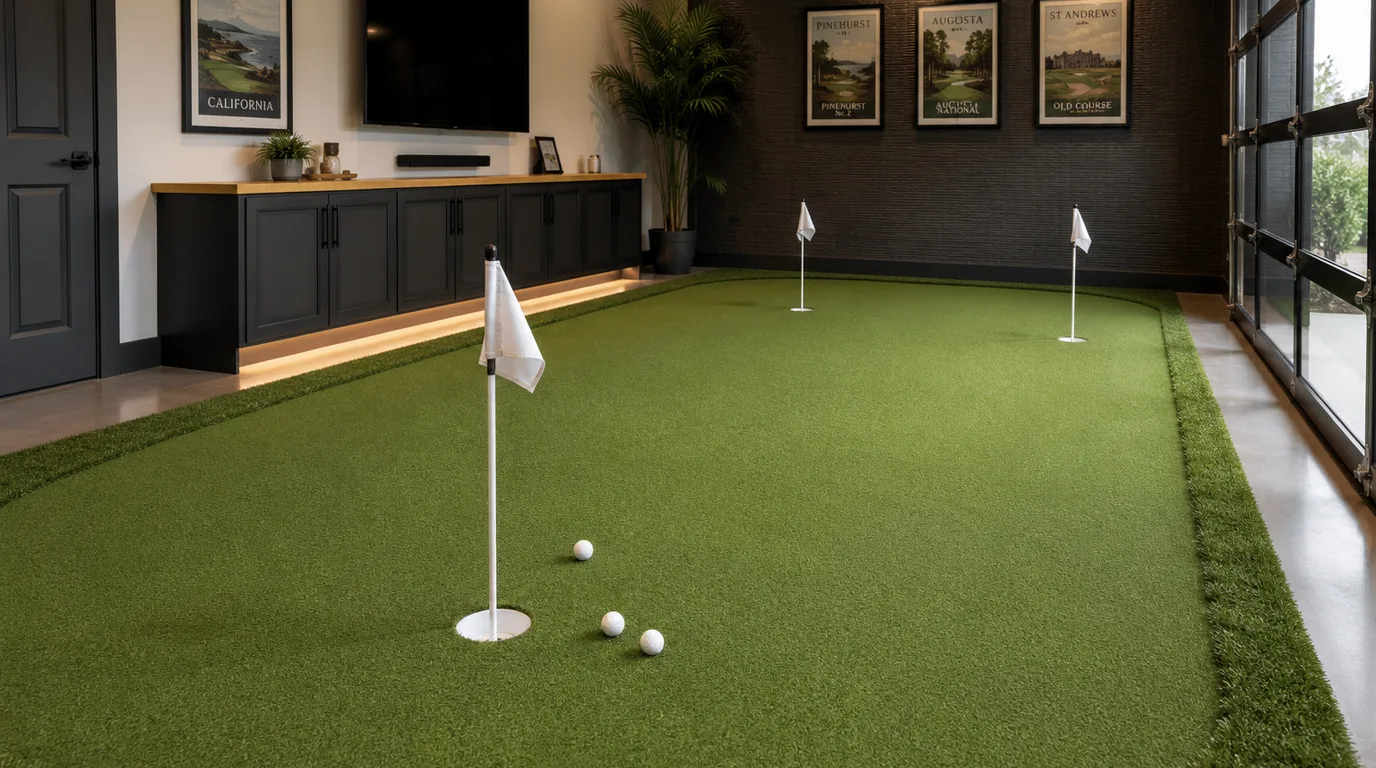
Indoor putting green. This is where our turf genuinely shines indoors. A short, dense putting green turf with silica sand brushed in rolls true on a flat floor, and you can build breaks with a thin underlay. Sink putts in January without leaving the house — the dad-rock playlist is optional but encouraged.
Kids’ play area. Turf softens a playroom and hides the look of a hard floor, but for anywhere kids climb or jump, the surface under the turf matters more than the turf. The CPSC Public Playground Safety Handbook is built entirely around impact-attenuating surfacing — the short version indoors is: put a shock pad under the play zone. Our playground turf page covers the outdoor version of the same idea.
Pet relief and patios-that-aren’t. A turf potty area on a balcony or in a laundry room works the same as a pet lawn, minus the base. Free-draining where it needs to be, wiped clean where it doesn’t.
What Indoor Turf Costs
Turf is priced by the square foot, and ours costs the same indoors as it does in a backyard — Lush 70 from $1.19 a square foot for a budget-friendly, lower-pile roll that suits light indoor and play use, up to $1.99 for putting green turf. Contractor pricing for everyone, indoors or out.
What’s different is the stuff under and around it. A foam or rubber shock pad, double-sided seam tape or adhesive, and a moisture barrier for a basement slab all add to the material total, and a heavy-duty padded gym turf is its own price tier above landscape turf. None of it is a mystery, though. Run your square footage through the artificial turf calculator and you’ll have a real materials number before you so much as move a dumbbell.
Laying Indoor Turf Over a Hard Floor
The install is the easy part — no base means no heavy equipment. Start with a clean, dry, level subfloor; sweep it, and check a basement slab for damp. Roll out your underlayment or shock pad where you want cushion, then lay the turf with the blades all running the same direction so it reads as one surface, not a patchwork.
For a small space, loose-lay it or run double-sided turf tape around the edges and seams — done, and you can pull it up later. For a permanent install, glue it down. If you’re gluing in a closed room, use a low-VOC adhesive and ventilate while it cures: the EPA’s overview of volatile organic compounds is a good reminder that the fumes you want to avoid indoors come from the wet products, not the turf itself. Then, for a putting green, brush in your silica sand and roll it; everywhere else, a quick brush stands the blades up and you’re lifting by dinner.
Indoor Turf by Space
Match the turf and the underlayment to what the room actually does. Here’s the cheat sheet.
| Space | Pile & feel | Underlayment | Infill | Notes |
|---|---|---|---|---|
| Home gym (weights, sled) | Short, dense, durable | Foam or rubber shock pad | Non-infill or light sand | Padded gym-specific turf is best for heavy drops |
| Garage / cardio corner | Short to mid, low-pile | Pad optional | Light or none | Wipes clean; loose-lay or tape is plenty |
| Basement | Low-pile | Moisture barrier + pad | None | Check the slab for damp before anything goes down |
| Indoor putting green | Short putting turf | Smooth, firm underlay | Silica sand for the roll | Where our turf fits indoors best |
| Kids' play area | Mid-pile, soft | Impact-attenuating pad | None or light | The pad matters more than the turf for falls |
The turf is half the decision indoors — what goes under it (pad, moisture barrier, or nothing) is the other half.
Honest note on fit: for an indoor putting green, a garage, a play area, or a light home gym, our landscape turf is a genuinely good, well-priced answer. For a hardcore weight room with daily sled pushes and dropped Olympic plates, a purpose-built padded gym turf is the right tool, and we’ll point you there rather than sell you the wrong roll. Picking the durable option over the prettiest one is the whole game — same as choosing a W-Blade over a plush C-Blade for a high-traffic backyard.
Indoor Turf Mistakes to Avoid
Four ways an indoor turf project goes sideways. All of them are avoidable in about thirty seconds of planning.
Tall, Plush Turf in a Gym
A high-pile landscape roll crushes flat under equipment and looks tired in a month. Indoors, short and dense wins — save the plush for a front yard.
No Pad Under the Weights
Turf alone won't protect a slab from a dropped dumbbell or quiet the room. A foam or rubber shock pad under the lifting zone does both jobs.
Ignoring Subfloor Moisture
Laying turf over a damp basement slab traps moisture and invites mildew. Test the slab and add a moisture barrier before anything goes on top.
Gluing With Whatever's in the Garage
A high-VOC adhesive in a closed room is a bad afternoon. Use a low-VOC turf adhesive and ventilate — or skip glue entirely with double-sided tape.
Planning an Indoor Turf Space?
Tell us the room and what it's for, and we'll match the turf, the pad, and the infill to it — contractor pricing for everyone across Arizona and Utah.
- 4.9 from 300+ reviews
- 12-year manufacturer warranty
- Pickup & delivery, AZ & UT
What Customers Say
5.0 from 480+ verified Google reviews
So friendly and helpful! Came in with a specific need for my unfinished backyard and they had exactly what I needed. They were quick and even helped ratchet strap the grass roll onto the roof of my car (but delivery is an option!). The artificial grass is high quality and I’ll add a photo once I have it installed! 5/5 ⭐️ highly recommend and will utilize again for future projects!
I’m a FLOORING CONTRACTOR and the quality of material that I purchased here was excellent and the price was great. I do appreciate the quality and the timely on the delivery. Everything turned out great thank you.
Expert Tips
— Bennett Brown, Co-Founder
Short and Dense Beats Tall and Soft
Indoors, pile height is durability, not luxury. A low, dense turf takes equipment and traffic; a tall plush roll lies down and quits on you.
Pad Under Impact, Not Everywhere
You don't need a shock pad under a whole room — just the weight zone, the sled lane, or the kids' corner. Pad where things land, save money everywhere else.
Test the Slab for Moisture
Tape a square of plastic to a basement floor overnight. Beads of water underneath means you need a moisture barrier before turf. Two minutes saves a mildew problem.
Tape Beats Glue for Small Rooms
Double-sided turf tape holds a garage or playroom fine, leaves no fumes, and lets you pull it up later. Save the adhesive for big permanent installs.
We'll Tell You When It's Not Our Turf
For a serious weight room, a padded gym turf beats anything in our landscape lineup. We'd rather point you to the right product than win the wrong sale.
— Bennett Brown, Co-Founder
Related Services
Indoor turf is the rare project that’s easier than it looks: no base, no drainage, just a clean floor, the right roll, and a pad where it counts. We supply the turf and the straight answers across the Arizona service area from our Mesa yard and across Utah from Provo — call Mesa at (480) 910-2440 or Provo at (385) 335-9042, swing by for a free sample, and tell us what the room is for. We’ll help you pick it, price it, and load it. The putting-green-in-the-basement idea is free; the missed putts are on you.