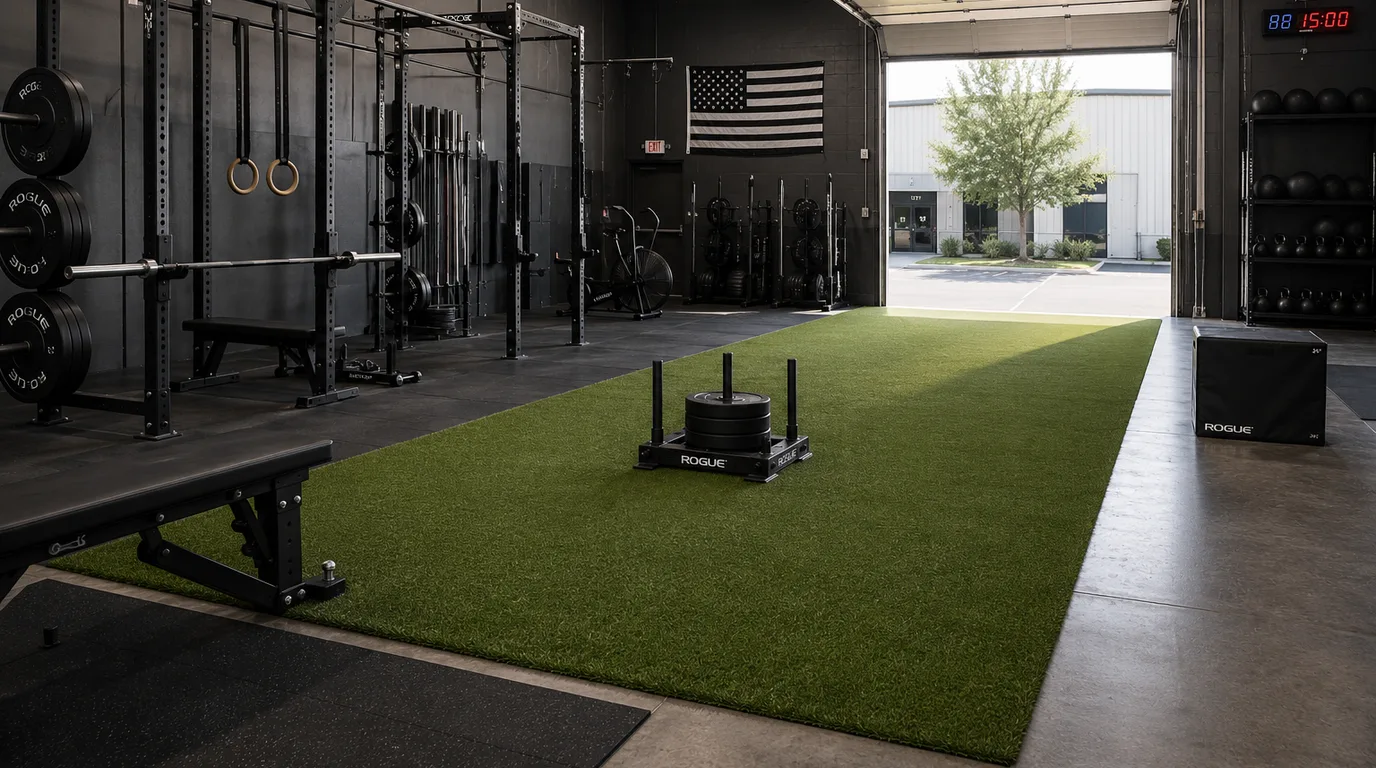
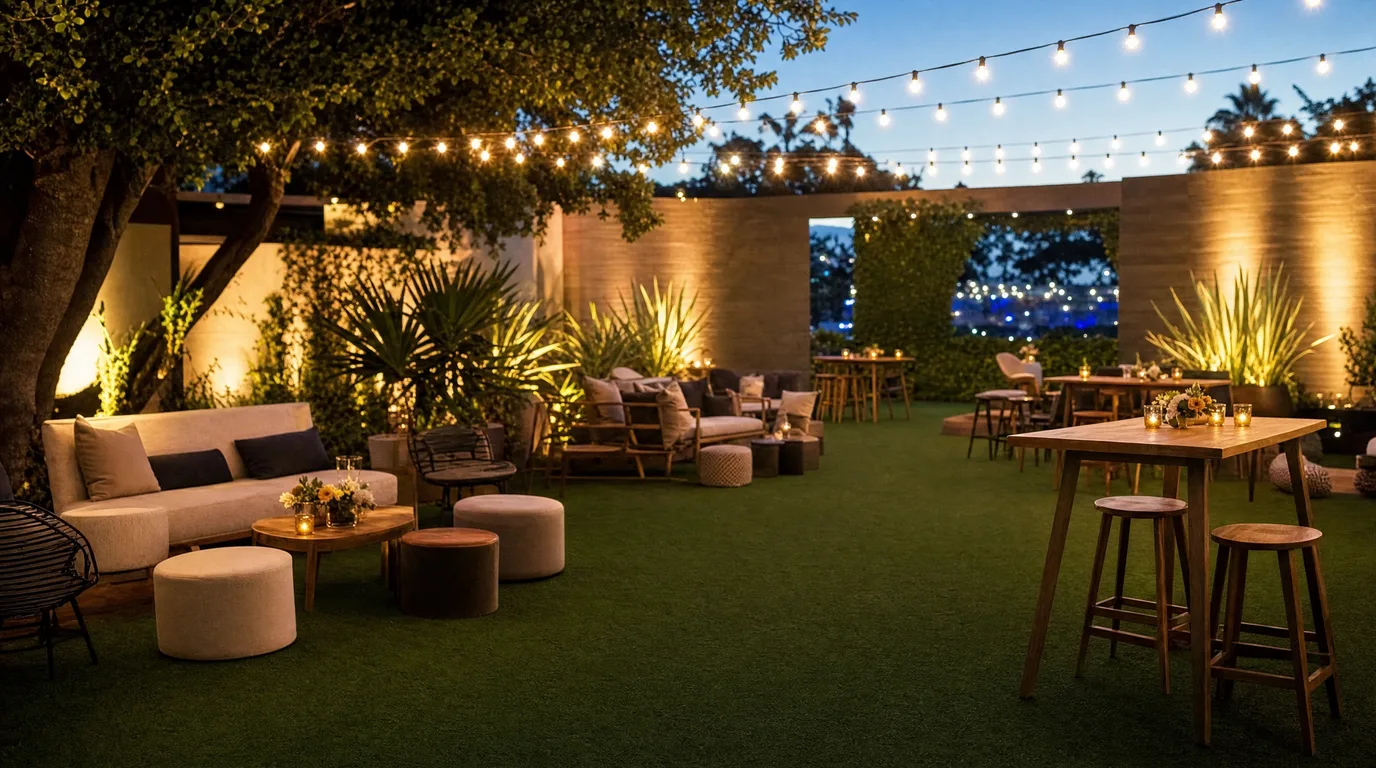
We get the same call every spring, usually from someone who needs green grass on a concrete floor by Friday. A wedding planner dressing a parking-lot venue. An exhibitor who wants a booth that doesn’t look like every other booth. A brand setting up a pop-up shop in a downtown plaza. The answer to all three is the same, and it isn’t sod.
Turf for events is a temporary install — synthetic grass rolled straight over a hard surface, seamed, edged, and pulled up again when the party’s over. No digging, no permanent base, no permits, and no irrigation truck idling in the loading zone. It goes down in a few hours and comes back up the same day. Sod can’t do that, and rented carpet has never once made anyone gasp.
TL;DR — Quick Answer
Turf for events is a temporary install laid over concrete, pavers, or asphalt — no excavation and no permanent base. You roll it out, seam the panels, and hold the edges with tape, sandbags, or weighted trim. It's down in a few hours and up again the same day, and the rolls reuse for dozens of events if you store them rolled, not folded.
Best for
Weddings, trade shows, pop-ups
Setup time
A few hours, no base prep
Roll width
12 or 15 ft, cut to 100 ft
Most common mistake
Ordering last-minute
Supplying an Event or Trade Show?
Tell us the venue and your square footage. We cut event turf to spec from the Mesa and Provo yards and deliver across Arizona and Utah.
Table of Contents
Key Takeaways
- Turf for events lays over any hard, flat surface — concrete, pavers, asphalt — with no excavation, no permanent base, and no permits.
- A proper temporary setup goes down in a few hours and comes back up the same day, so it works for single-day and multi-day events alike.
- Rolls come 12 or 15 feet wide and cut to length up to 100 feet, so you order the footprint you need instead of working around retail sizes.
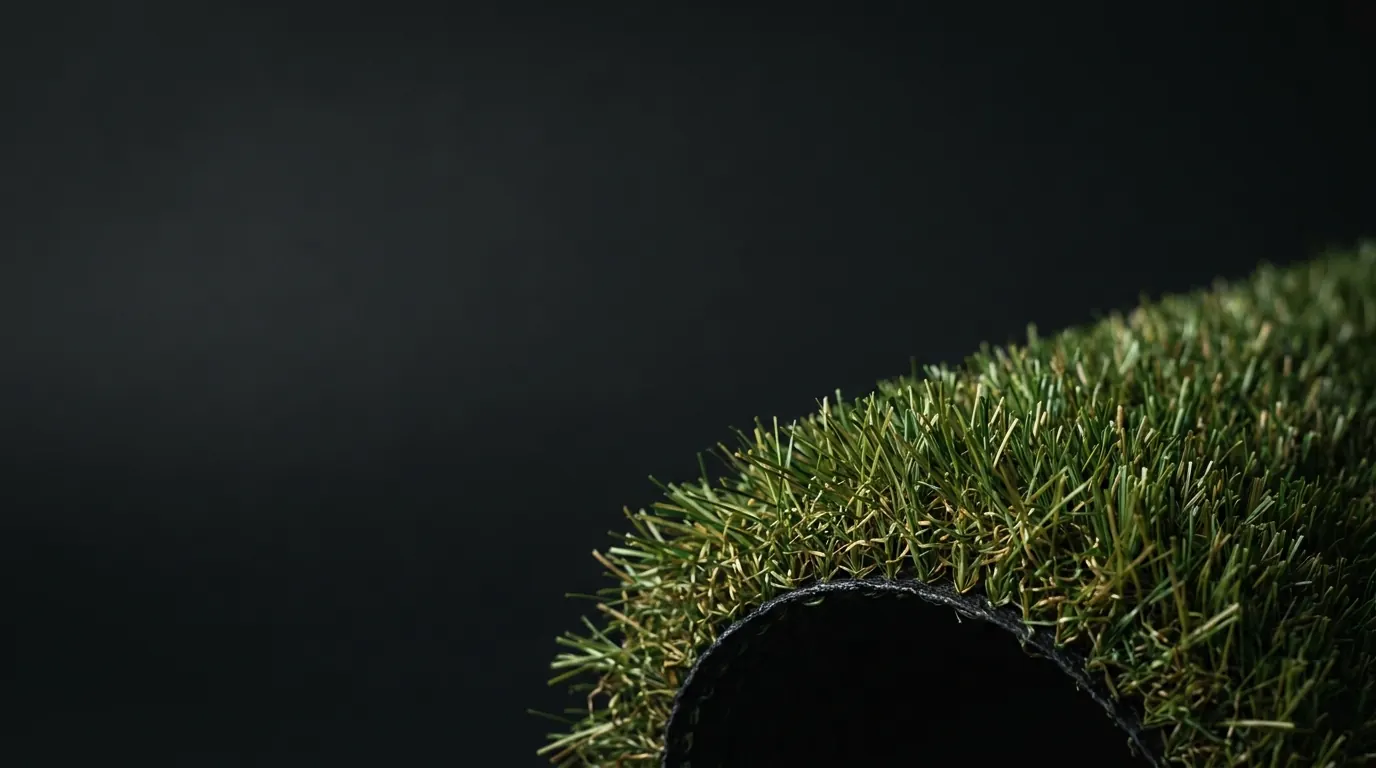
- Buying rolls usually beats renting by the second or third use — the turf handles dozens of installs if you store it rolled on a core, never folded.
- We cut to spec from the Mesa and Provo yards and deliver by the mile: $3.00 a mile for a small roll, $2.75 for a large one.
Where Temporary Turf Installs Work Best
“Event turf” tends to conjure one image, and then people are surprised by the range. Over the last few years we’ve cut turf for nearly every kind of temporary setup the Valley and Utah County can throw at us. A few that come up most:
Weddings and ceremonies. A turf aisle or a ceremony backdrop turns a bare ballroom floor or a parking-lot venue into something that photographs green. It pairs with a floral arch and reads far better on camera than indoor carpet or bare pavement. Nobody’s ever framed a photo of poured concrete.
Corporate events and brand activations. Companies use turf to define a space — a lounge at an outdoor event, a branded photo zone, a company picnic on a paved courtyard. Green signals outdoor and natural, and it holds up under event lighting.
Trade shows and exhibitions. Convention floors are hard, echoing concrete, and most booths fight it with the same gray carpet squares. A turf section on your booth floor makes the space feel warmer and finished — and different from the forty booths next to you. The exhibitions world has a whole professional body for this kind of detail; the International Association of Exhibitions and Events exists because booth presentation moves the needle on a show floor.
Pop-up retail and activations. Brands running pop-ups in parking lots or urban plazas use turf to create a defined, polished footprint that looks intentional from the street, not improvised.
Photo backdrops and content studios. A turf panel as a vertical backdrop, or a low turf floor for product shots, gives a consistent green that doesn’t need Photoshop to look real.
Rooftop terraces and hard-surface decks. Rooftop venues are everywhere in Phoenix and Scottsdale now. Turf over a sealed concrete or tile deck brings color and texture without the weight or permanence of a planted install.
Why Turf Beats the Alternatives for Events
Here’s the short version of why the wedding planner keeps calling us instead of the sod farm.
It’s the fastest path to green. Paint wears and looks flat. Real sod is heavy, messy, and wants water within hours. Potted plants take days to arrange and a forklift to move. Turf rolls out in hours and looks finished the moment it’s down.
It’s reusable and built for sun. A quality roll with a UV-stabilized backing won’t fade or degrade from a weekend outdoors. Arizona and Utah sun is brutal, but our commercial turf carries a 12-year manufacturer warranty for exactly that reason. Roll it up after, store it right, and it’s ready for the next call.
It’s clean underfoot. No mud, no dirt tracked across a ballroom floor, no watering puddles around the bar. For indoor venues especially, that’s the whole sell — coordinators do not want soil on the marble.
It cuts to any shape. Unlike modular tile, turf cuts with a utility knife and a straight edge. Curved edges around a dance floor, a branded silhouette, a path through a booth — all doable on site. For the industry-standard view on selecting and installing synthetic turf, the Synthetic Turf Council’s technical guidelines are a solid, non-salesy reference.
How a Temporary Install Actually Works
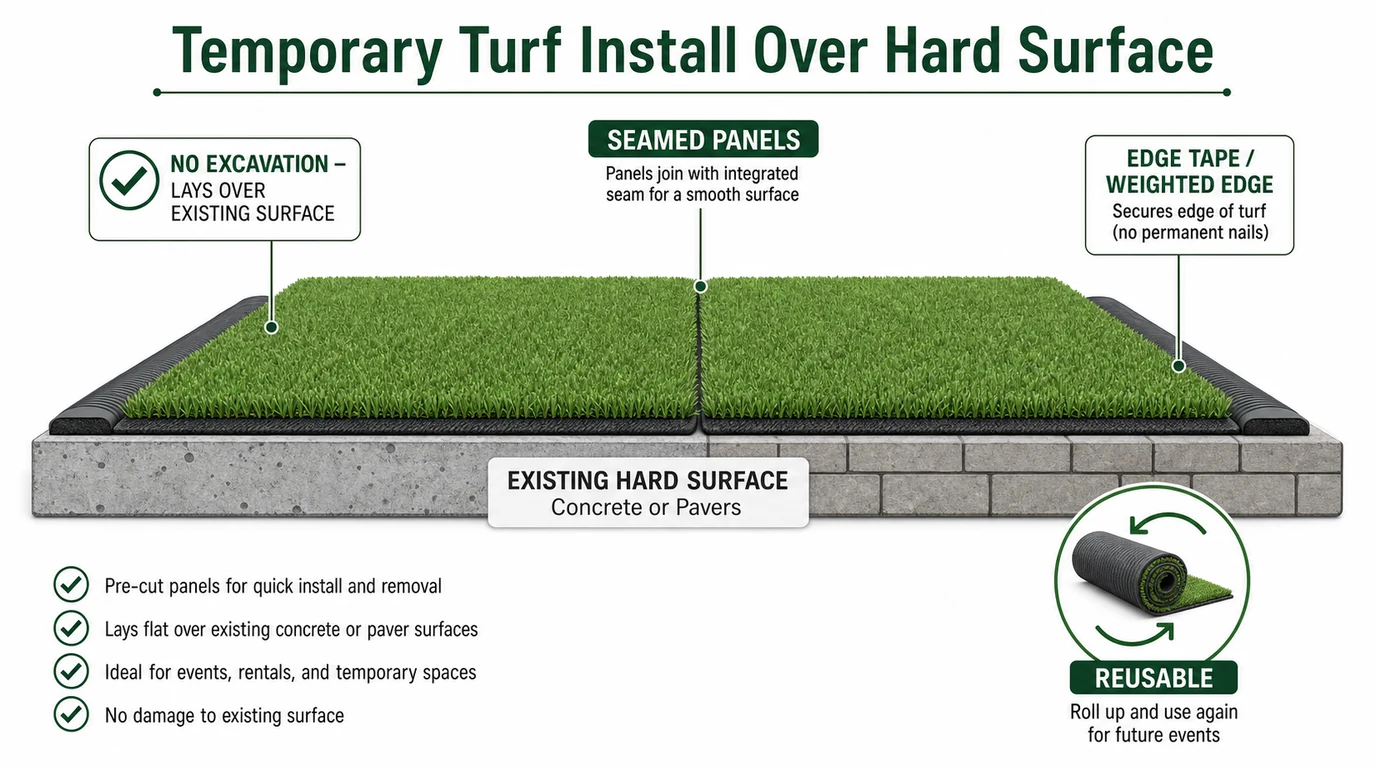
The method is simpler than people expect, and the key word is temporary. No excavation, no compacted base, no permanent anchoring. The whole job is four moves.
- Clean the surface. Sweep or blow off debris. Grit left under the turf turns into lumps you’ll feel through the soles of every guest.
- Roll out and cut. Lay the rolls with the grain running the same way. A utility knife and a straight edge get you clean edges and a tidy perimeter.
- Seam the panels. Butt the edges together — no overlap — and run seaming tape underneath. For a same-day or overnight event you’re pulling up afterward, a strong double-sided tape is often enough on its own.
- Secure the perimeter. Indoors on smooth concrete, double-sided carpet tape holds the edges and releases clean. Outdoors, weight the border with edge trim, sandbags, or furniture set on the edge. Skip screws and staples if the floor has to be undamaged on the way out.
That’s the install. For the deeper version of seaming and base work, our how to install artificial turf guide walks through it — most of the seaming principles carry straight over to temporary jobs.
Managing traffic and load. Trade show crowds and a room full of spiked heels are hard on light turf. A denser, heavier roll holds up better — Lush 80 at a 1.58-inch pile is the workhorse for most of our event jobs. Rolling gear like AV carts and dollies should run solid-rubber wheels, not narrow metal casters that dig into the backing.
Seams that disappear on camera. For photo-heavy events, brush the pile toward the camera side and keep the blade direction consistent across panels. From any normal viewing angle, a well-done seam vanishes. Your photographer will never know it was two rolls.
Rent vs. Buy: The Honest Math
This is the question everybody actually called about, so let’s be straight about it.
| Rent It | Buy the Rolls | |
|---|---|---|
| Best for | A one-off event with no future use in mind | A venue, an event company, or a regular activation calendar |
| Upfront cost | Lower for a single event | Higher once — then it's yours for dozens of installs |
| Storage | None — it goes back | You store it rolled on a core in a dry space |
| Where it pays off | Stays cheaper only if you truly use it once | Usually wins by the second or third use |
| Lifespan | Not your concern | Dozens of temporary installs if rolled, never folded |
One event and done, rent it. A venue or a recurring calendar, buying rolls almost always wins by the second or third use.
If you run events regularly — a venue hosting dozens a year, a production company juggling clients, a corporate team doing seasonal activations — buying is almost always cheaper by the second or third use. Run your square footage through our artificial turf calculator, compare it to renting the same coverage three or four times, and purchase usually wins. It’s not a midlife crisis, it’s a mid-pile crisis, and it resolves cheaply.
Estimate Your Event Footprint
Enter your square footage and the calculator outputs how much turf to order — handy whether you're comparing rent-vs-buy or sizing a booth.
Cleanup, Storage, and Reuse
Teardown is the reverse of setup, and it’s where the reusable part lives or dies. Pull the perimeter tape or weights, peel the seams, and roll each panel back up — onto a tube or a core, never folded. A fold creases the backing, and a creased backing is the one thing a season of careful storage won’t fix.
Give the rolls a quick rinse if they picked up spilled drinks or floor grime, let them dry before you store them, and keep them out of prolonged sun between uses. Stored that way, the same rolls handle dozens of events — synthetic turf is built to last years in far harsher use, which is the whole reason the Synthetic Turf Council exists as an industry body. If a high-pet or high-traffic job left odor in the pile, a zeolite infill refresh sorts it — but for a clean ballroom floor, a rinse and a dry is the whole routine.
Delivery and Offloading
We deliver and offload, and we price it by the mile instead of hiding it in the material rate. A small roll runs $3.00 per mile; a large roll runs $2.75 per mile, from either the Mesa or Provo yard. Event turf rolls are heavy and awkward — exactly the thing you don’t want to wrestle off a truck in a dress shirt an hour before doors. We’ll help you offload it, both literally and, on a stressful setup day, emotionally.
Tell us the venue address and the square footage and we’ll quote the material and the delivery run together, so there are no surprises when the truck pulls up.
Arizona and Utah Conditions
Same turf, two climates, two small notes.
Arizona. For outdoor summer events in Phoenix, Scottsdale, or Mesa, plan around heat. Turf over concrete in full August sun gets hot — so does every other outdoor surface in 110-degree weather. A quick hose rinse drops the surface temperature fast, and shaded or evening venues skip the issue entirely. Indoors, in an air-conditioned hall, it’s a non-issue. Our full breakdown lives in does artificial turf get hot.
Utah. For spring events in Salt Lake City or Provo where mornings still dip cold, turf laid over chilly pavement holds up fine. There’s no freeze-thaw worry on a temporary surface install the way there’d be with a permanent base — you’re rolling it up before winter ever gets a vote.
Common Event-Turf Mistakes
Most event-turf regrets trace back to the same three things, and all three are avoidable with a phone call.
Undersizing the Footprint
Measuring the dance floor and forgetting the aisle, the perimeter, or the photo zone. Sketch the full layout and add a margin — a seam in the wrong spot is harder to fix than a few extra feet of turf.
No Surface or Edge Plan
Showing up without a plan to secure the edges, then improvising with whatever's in the van. Decide upfront: tape indoors, weighted trim or sandbags outdoors, and never screws if the floor has to survive.
Ordering Last-Minute
Calling Thursday for a Saturday event. Cut-to-spec orders need lead time to cut, stage, and route the delivery. Give us the date early and the rest is easy.
Folding the Rolls for Storage
Folding a roll to fit it in a smaller space creases the backing for good. Always store rolled on a core, on end or flat, in a dry space — that's what makes it reusable.
Need Green on a Concrete Floor by Friday?
We cut event and commercial turf to spec from the Mesa and Provo yards and deliver across Arizona and Utah — for planners, exhibitors, venues, and corporate teams.
- 4.9 from 300+ reviews
- 12-year manufacturer warranty
- Cut to length up to 100 ft
- Arizona & Utah
What Customers Say
5.0 from 480+ verified Google reviews
I’m a FLOORING CONTRACTOR and the quality of material that I purchased here was excellent and the price was great. I do appreciate the quality and the timely on the delivery. Everything turned out great thank you.
I had messaged their sales rep on a Sunday, and they were quick with their response time and actually had my delivery next day! They’re very knowledgeable in what turf worked best for my needs and what aesthetic I wanted. 10/10 communication, 10/10 material, and 10/10 in delivery. I look forward to my next project with them!
Expert Tips
— Bennett Brown, Co-Founder
Sketch the Full Layout First
Measure the whole footprint — aisle, perimeter, photo zone, the lot — not just the centerpiece. It tells us where to put seams and keeps you from ordering short.
Go Denser for Heels and Crowds
Spiked heels and trade show traffic punish light turf. Lush 80 at a 1.58-inch pile is my default for event work — it reads real on camera and takes the foot traffic.
Tape Indoors, Weight Outdoors
Smooth concrete indoors holds with double-sided carpet tape that releases clean. Outdoors, weight the perimeter with trim or sandbags. Skip screws if the floor has to survive.
Brush Seams Toward the Camera
Keep the blade direction consistent across panels and brush the pile toward the camera side. A well-done seam disappears at any normal focal length.
Store It Rolled, Never Folded
A crease in the backing is the one thing you don't get back. Roll each panel onto a core, keep it dry and out of the sun, and it'll outlast a lot of events.
Call Early, Not Thursday
Cut-to-spec orders need lead time to cut, stage, and route delivery. Give us the date and the square footage early and setup day stays boring — which is the goal.
— Bennett Brown, Co-Founder
Related Services
When you’re ready for materials, we supply commercial and event turf cut to spec from the Mesa yard across the Arizona service area and from Provo across Utah, with wholesale quantities for event production companies and repeat buyers. Call Mesa at (480) 910-2440 or Provo at (385) 335-9042, tell us the venue and the square footage, and we’ll cut it, price it, and load it. Green grass on a concrete floor by Friday is a normal Tuesday for us — the panic is optional.