We get the infill question constantly, usually right before someone orders materials and discovers the bags weigh more than their last vacation suitcase. How much infill for synthetic grass comes down to a simple range: plan on 1 to 2 pounds per square foot, then nudge up or down for pile height and how hard the yard gets used. That’s the answer. Everything below is just where you land in that range, and how not to under-order.
Here’s the honest part. Of all the corners people cut on a turf install, skimping on infill is the most common one I see come back to bite them. It’s the cheapest material in the whole job and it’s the one that holds the blades up, helps the surface drain, and weighs the turf down so it doesn’t wrinkle when the desert heats it. Cut it, and a $2-a-square-foot lawn starts looking like a $2 lawn.
TL;DR — Quick Answer
How much infill for synthetic grass? Plan on 1 to 2 pounds per square foot. Shorter pile and quiet areas land at the low end; taller pile, pets, and high traffic push toward the high end. Use silica sand for standard lawns and a zeolite like PetFill Pro for dog yards — then let the calculator turn your square footage into an exact number to order.
Rule of thumb
1–2 lbs per sq ft
Standard lawn pick
Natural Blend silica
Pet yard pick
PetFill Pro zeolite
Most common mistake
Under-filling to save money
Skip the Guesswork on Infill
Enter your square footage and pile height and the calculator outputs your exact infill quantity — plus turf yardage and base material — in one go.
Table of Contents
Key Takeaways
- Plan on 1 to 2 pounds of infill per square foot — pile height and use type decide where you land in that range.
- Infill is the cheapest material in the job and the one most people regret skimping on. Under-fill it and the blades flatten, the turf wrinkles, and drainage suffers.
- Silica sand (our Natural Blend, $7.50 a 50 lb bag in Arizona, $8.50 in Utah) is the standard pick for non-pet lawns.
- Dog yards need more infill, not less — and a zeolite like PetFill Pro, which traps odor in a way plain sand can't.
- Top off the infill about once a year, and let the calculator do the exact math before you order.
What Infill Actually Does
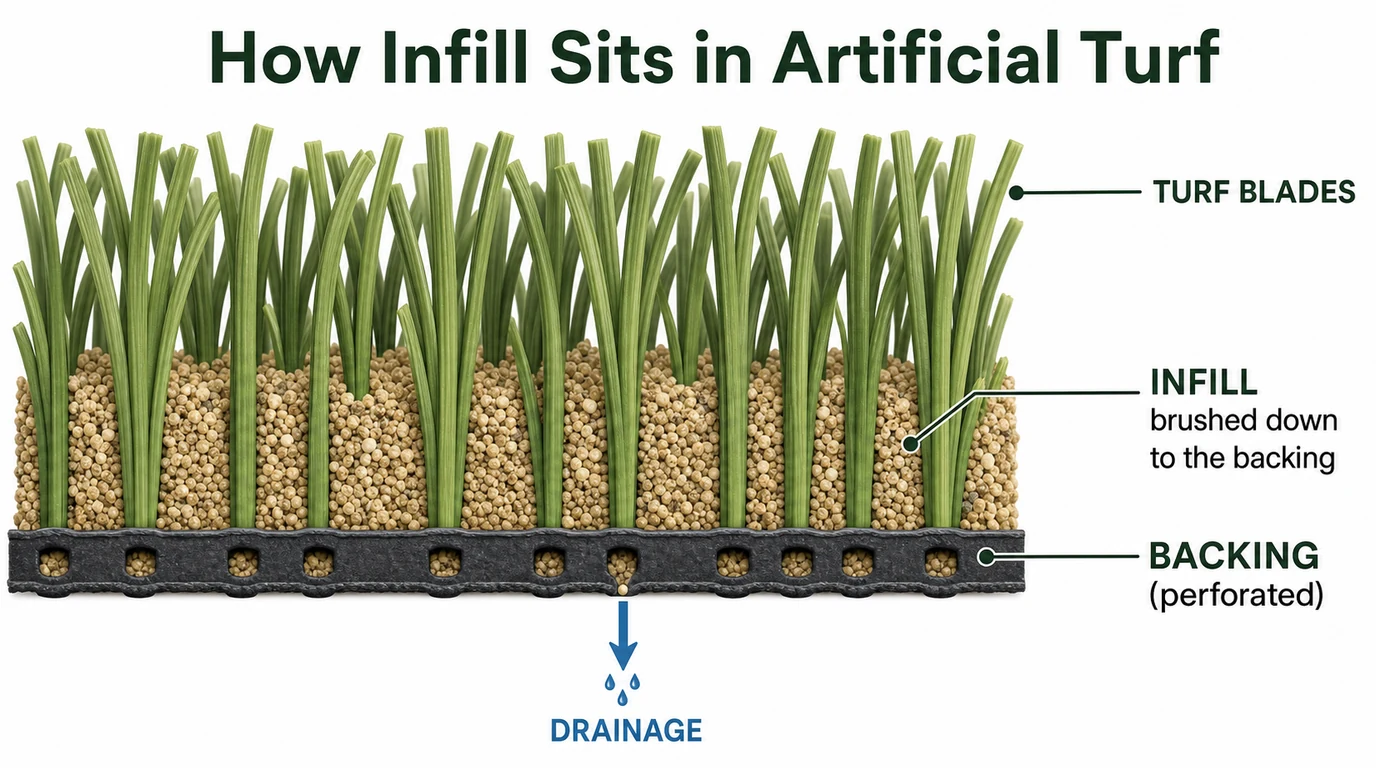
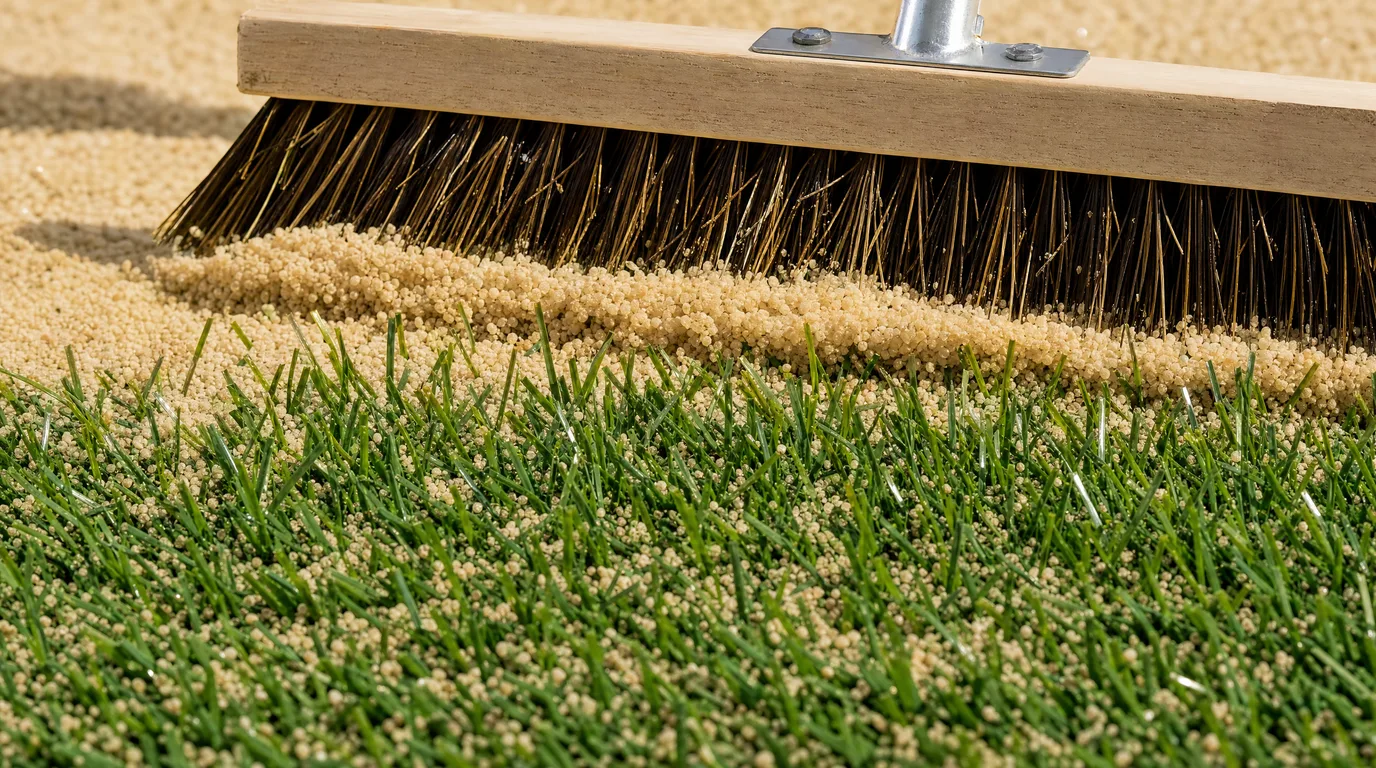
Infill is the granular material — usually silica sand or a coated zeolite — that gets brushed down into the base of the turf after it’s laid. It settles between the fibers, right at the backing, and it quietly does four jobs at once. It’s the unsung roadie of the turf system: you never notice it until it’s missing.
It weighs the turf down. This is the one people forget. Synthetic grass expands and contracts with the heat, and without enough infill holding it flat, it buckles a little when the temperature climbs. Those small wrinkles in a turf lawn are nine times out of ten an infill problem, not a bad-roll problem. Add infill before you blame the turf.
It holds the blades upright. Infill acts as a structural cushion at the base of the fibers, so they stand back up after foot traffic instead of lying over and staying there. Standing blades are most of what “looks natural” means once the turf is down.
It helps the surface drain. A properly filled turf lets water pass straight down between the blades and through the backing. An under-filled turf can actually drain slower, because the fibers mat together with nothing keeping them apart. The Synthetic Turf Council, the industry’s trade group, treats infill as a core part of a working turf system, not an optional extra — and that matches what we see in the field.
It adds cushion. For kids’ play areas, dog runs, or any lawn where people actually spend time on the ground, infill gives you a bit of give underfoot instead of a thin pad over hard base.
How Much Infill You Need
The baseline we use in the field — and the standard across the industry — is 1 to 2 pounds of infill per square foot. It’s a range, not a single number, and the spread is the whole point. Where you land comes down to three things.
Pile height. Shorter pile turf (around 30mm and under) needs less — you’re filling a shallower column of fiber. Taller pile (35–40mm and up) needs more to fill the system and support the blades. If you’re running something plush like our Lush Primo at a 1.77-inch pile, budget toward the high end.
Use type. A decorative side yard or a rooftop sees almost no traffic and can sit at the low end. A backyard with kids, a dog, and a daily parade of foot traffic needs more to stay resilient. Commercial and high-traffic installs spec on the higher side to hold pile recovery over the years.
The product spec. Every turf product has its own recommended infill rate based on its backing, stitch rate, and fiber build. When you shop our turf infill options or pick a turf product, the spec sheet (or our team at the counter) gives you the manufacturer’s rate for that exact product. Follow that over a guess every time — that’s the rule of thumb the rule of thumb defers to.
Quick gut check on the math. A 1,000 square foot lawn at the midpoint (1.5 lbs/sq ft) needs roughly 1,500 pounds — about 30 of our 50 lb bags. Under-order and you’re short mid-job with a power broom in your hand and nowhere to go. Over-order and you’ve paid for sand you’re storing in the garage until next spring. This is exactly the arithmetic the calculator exists to kill.
Types of Infill: Silica, Zeolite, and Rubber
Not all infill is the same material, and the choice changes performance, pet odor, and how the turf ages. Three show up in our markets.
Natural Blend Silica Sand
Silica sand is the workhorse — consistent, easy to brush in, and the right call for most non-pet residential lawns. Our Natural Blend runs $7.50 a 50 lb bag in Arizona and $8.50 in Utah, which makes it the cheapest material on the order sheet. The grains are rounded and uniform, so they brush into the pile evenly and don’t compact aggressively. Silica is just a refined version of the crystalline silica that makes up a big chunk of the earth’s crust, which is a fancy way of saying: it’s sand, and it’s been doing this job under lawns for a long time.
For a standard front or back yard in Phoenix or Provo, this is the default and it holds up.
PetFill Pro Zeolite
For dog yards, plain silica doesn’t pull its weight on odor. A zeolite infill is a mineral that actually traps and neutralizes the ammonia that causes the smell, instead of letting it sit in the pile and announce itself every July. Our PetFill Pro runs $22 a 50 lb bag in Arizona and $25 in Utah. It costs more than sand, but in a dog run it’s the difference between a fresh yard and one your neighbors can locate with their eyes closed.
Crumb Rubber
Crumb rubber — recycled tire material — shows up on sports turf and some commercial fields, where it adds cushion. For a backyard lawn we generally steer away from it: it runs hotter than sand in full Arizona sun, and the little particles track inside onto your floors. It’s also the infill that’s drawn the most scrutiny — the EPA’s federal research program has spent years studying crumb rubber on playing fields. If you’re building a sports turf surface it may be in the spec; for a residential lawn, we point you toward sand or a coated product.
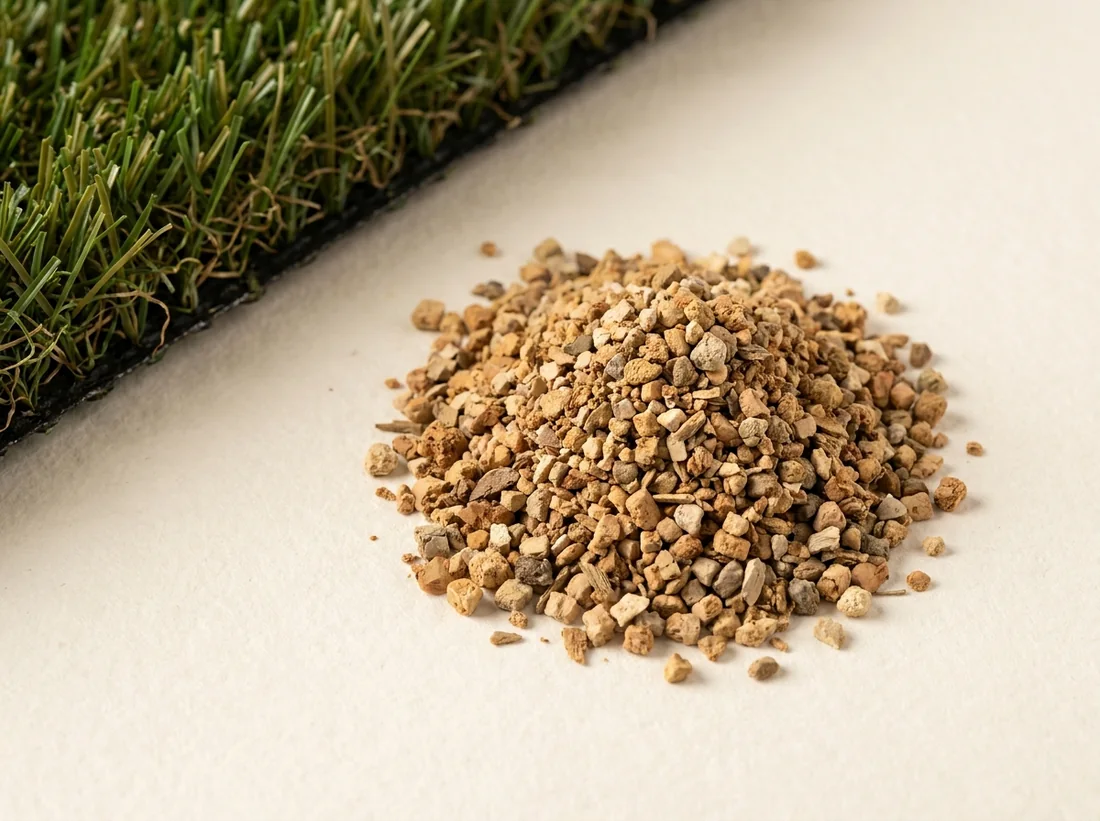
Natural Blend Pro Turf Infill Artificial Turf
Turf infill that supports blade stability, cushioning, drainage, and overall surface resilience.
View Turf Infill →Pet Yards Need More, Not Less
Dog yards deserve their own note, because the instinct to go light on infill is exactly backwards here. Between the drainage demand, the odor, and a dog who runs the same line across the yard a hundred times a day, pet turf gets specced with more infill, not less.
More infill means better blade support in those worn lanes, better drainage spread, and more surface area for the zeolite to work against the ammonia. If you’re building a dog run or any dedicated pet turf area, plan toward the high end of the range and use a zeolite throughout. I’ve lost count of the pet installs that used a thin layer of plain sand to save a few bags — within a year or two the pile is flat and the odor control was never there to begin with. That’s a false economy with a smell.
Topping Off Infill Each Year
Infill isn’t a one-time pour. Over the years it compacts, migrates, and drifts toward the perimeter — fastest in the high-traffic lanes. That’s normal and expected, not a defect. Part of routine turf maintenance is checking your levels once a year and brushing fresh infill into anywhere it’s run thin.
It’s a small job with an outsized payoff. A bag or two of Natural Blend and twenty minutes with a stiff brush — or a power broom if you’ve got one — resets the blades, restores drainage, and keeps the turf flat in the heat. For the full step-by-step, our how to install artificial turf guide walks through infill application and how to set it evenly.
Infill at a Glance
If you skim one section, make it this one. Here’s the short version of which infill goes where.
| Infill type | What it does | Who it's for |
|---|---|---|
| Natural Blend silica sand | Weighs turf down, supports blades, helps drainage. The all-purpose workhorse. | Standard residential lawns, front yards, and decorative areas. $7.50/bag AZ, $8.50 UT. |
| PetFill Pro zeolite | Everything sand does, plus it traps and neutralizes pet-urine ammonia. | Dog runs and any pet area where odor control matters. $22/bag AZ, $25 UT. |
| Crumb rubber | Adds cushion and impact absorption. Runs hot and can track indoors. | Sports and athletic fields. Rarely the pick for a residential yard. |
Coverage for all three lands in the 1–2 lbs/sq ft range; pile height and use decide where. Natural Blend and PetFill Pro come in 50 lb bags.
The Infill Mistakes I See Most
These are the four that come back to the yard as complaints, every one of them avoidable at install time for the price of a few more bags.
Under-Filling to Save Money
Infill is the cheapest material in the job. Go light and the blades flatten, the turf wrinkles, and drainage suffers. You don't save money — you front-load a regret.
Plain Sand in a Dog Yard
Silica does nothing for odor. In a pet area you want a zeolite like PetFill Pro that traps the ammonia. Sand in a dog run is a smell with a countdown timer.
Skipping the Yearly Top-Off
Infill compacts and drifts to the edges over time. Skip the once-a-year top-off and the worn lanes go flat. A bag or two and a brush resets it.
No Infill at All
A few engineered systems tolerate low infill, but most need it. Run a standard turf with none and it wrinkles in the heat and shifts underfoot. Don't trust a no-infill marketing pitch on a standard roll.
Not Sure How Much Infill Your Yard Needs?
We'll help you pick the right infill type and the right quantity — for homeowners, DIYers, and contractors across Arizona and Utah. Contractor pricing for everyone.
- 4.9 from 300+ reviews
- 12-year manufacturer warranty
- Free quote & free sample
- Arizona & Utah
What Customers Say
5.0 from 480+ verified Google reviews
The quality for the price is fantastic!! The staff I dealt with were super friendly and helpful. Not to mention, they cut multiple lengths for me and were at my driveway the same day I placed the order.
AWESOME EXPERIENCE. I was working with a different supplier who fell through and I’m on a bit of a time crunch on my project. I hit up The Turf Yard and they gave me a very reasonable price for the turf and were able to deliver it the same day. I was extremely impressed. I would 200% recommend and will be coming back for more business when I’m ready to finish my project in it’s entirety. Thanks y’all!
Expert Tips
— Bennett Brown, Co-Founder
Buy a Few Bags Over, Not Under
Order a 5 to 10% buffer for edges, top-ups, and the spots that drink more than you expected. Running short mid-install is a bad afternoon; a leftover bag is a free top-off next year.
Match the Spec, Not Just the Rule
The 1–2 lbs/sq ft range is a sanity check. The turf product's own recommended rate is the real number — follow the spec sheet over the rule of thumb.
Go Heavier on Tall Pile
A 1.77-inch Lush Primo holds more infill than a short-pile turf. Taller fiber, deeper column, more material to fill it and stand it up.
Use Zeolite for Dogs, Every Time
Plain sand buys you a few months of denial. PetFill Pro traps the ammonia at the source — it's the single best thing you can do for a pet yard's smell.
Top Off Once a Year
Check your levels every spring and brush fresh infill into the worn lanes. It holds the blades up, keeps drainage open, and stops the heat wrinkles before they start.
Let the Calculator Do the Math
Have accurate square footage and your pile height, and the calculator handles the rest — infill, turf yardage, and base material in one shot. Your job is the measuring tape.
— Bennett Brown, Co-Founder
Related Services
When you’re ready, we supply the turf, the base, and the infill — with free samples and straight answers — across the Arizona service area from our Mesa yard and across Utah from Provo. Call Mesa at (480) 910-2440 or Provo at (385) 335-9042, and we’ll help you land the right infill type and the right quantity for your yard. It’s the cheapest part of the job to get right, and the most expensive to get wrong — so let’s get it right, and leave the regret to your old water bill.